
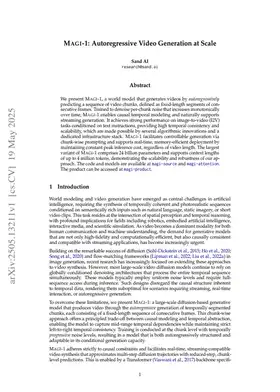
MAGI-1: Autoregressive Video Generation at Scale
We present MAGI-1, a world model that generates videos by autoregressively predicting a sequence of video chunks, defined as fixed-length segments of consecutive frames. Trained to denoise per-chunk noise that increases monotonically over time, MAGI-1 enables causal temporal modeling and naturally supports streaming generation. It achieves strong performance on image-to-video (I2V) tasks condition
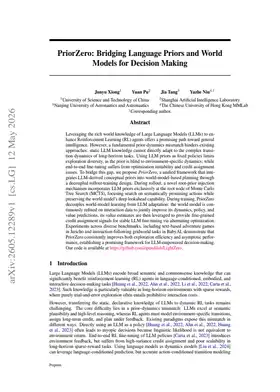
PriorZero: Bridging Language Priors and World Models for Decision Making
Leveraging the rich world knowledge of Large Language Models (LLMs) to enhance Reinforcement Learning (RL) agents offers a promising path toward general intelligence. However, a fundamental prior-dynamics mismatch hinders existing approaches: static LLM knowledge cannot directly adapt to the complex transition dynamics of long-horizon tasks. Using LLM priors as fixed policies limits exploration di
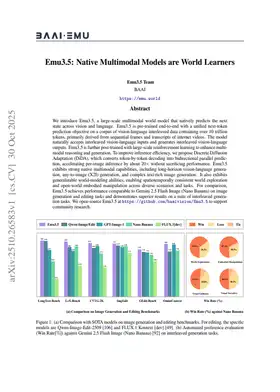
Emu3.5: Native Multimodal Models are World Learners
We introduce Emu3.5, a large-scale multimodal world model that natively predicts the next state across vision and language. Emu3.5 is pre-trained end-to-end with a unified next-token prediction objective on a corpus of vision-language interleaved data containing over 10 trillion tokens, primarily derived from sequential frames and transcripts of internet videos. The model naturally accepts interle
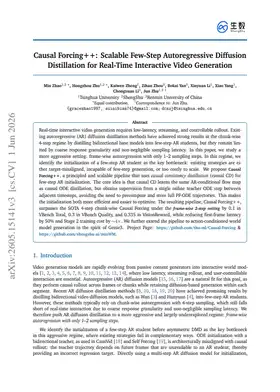
Causal Forcing++: Scalable Few-Step Autoregressive Diffusion Distillation for Real-Time Interactive Video Generation
Real-time interactive video generation requires low-latency, streaming, and controllable rollout. Existing autoregressive (AR) diffusion distillation methods have achieved strong results in the chunk-wise 4-step regime by distilling bidirectional base models into few-step AR students, but they remain limited by coarse response granularity and non-negligible sampling latency. In this paper, we stud
What Drives Success in Physical Planning with Joint-Embedding Predictive World Models?
A long-standing challenge in AI is to develop agents capable of solving a wide range of physical tasks and generalizing to new, unseen tasks and environments. A popular recent approach involves training a world model from state-action trajectories and subsequently use it with a planning algorithm to solve new tasks. Planning is commonly performed in the input space, but a recent family of methods
Large VLM-based Vision-Language-Action Models for Robotic Manipulation: A Survey
Robotic manipulation, a key frontier in robotics and embodied AI, requires precise motor control and multimodal understanding, yet traditional rule-based methods fail to scale or generalize in unstructured, novel environments. In recent years, Vision-Language-Action (VLA) models, built upon Large Vision-Language Models (VLMs) pretrained on vast image-text datasets, have emerged as a transformative
A Comprehensive Survey on World Models for Embodied AI
Embodied AI requires agents that perceive, act, and anticipate how actions reshape future world states. World models serve as internal simulators that capture environment dynamics, enabling forward and counterfactual rollouts to support perception, prediction, and decision making. This survey presents a unified framework for world models in embodied AI. Specifically, we formalize the problem setti
Towards Unified World Models for Visual Navigation via Memory-Augmented Planning and Foresight
Enabling embodied agents to imagine future states is essential for robust and generalizable visual navigation. Yet, state-of-the-art systems typically rely on modular designs that decouple navigation planning from visual world modeling, which often induces state-action misalignment and weak adaptability in novel or dynamic scenarios. We propose UniWM, a unified, memory-augmented world model that i
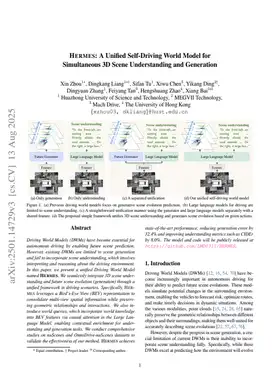
HERMES: A Unified Self-Driving World Model for Simultaneous 3D Scene Understanding and Generation
Driving World Models (DWMs) have become essential for autonomous driving by enabling future scene prediction. However, existing DWMs are limited to scene generation and fail to incorporate scene understanding, which involves interpreting and reasoning about the driving environment. In this paper, we present a unified Driving World Model named HERMES. We seamlessly integrate 3D scene understanding
Towards Interactive Video World Modeling: Frontiers, Challenges, Benchmarks, and Future Trends
With rapid development of large language models and diffusion-based content generation, world modeling has attracted increasing research attention, benefiting various downstream domains such as game engines, embodied AI, autonomous driving, etc. Through explicitly incorporating user actions into world state transition, recent literature empowers world modeling with interactivity in an action-condi
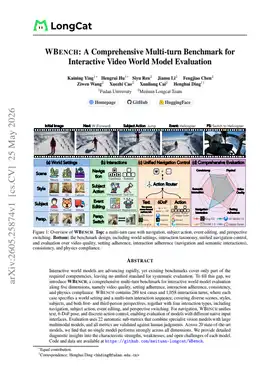
WBench: A Comprehensive Multi-turn Benchmark for Interactive Video World Model Evaluation
Interactive world models are advancing rapidly, yet existing benchmarks cover only part of the required competencies, leaving no unified standard for systematic evaluation. To fill this gap, we introduce WBench, a comprehensive multi-turn benchmark for interactive world model evaluation along five dimensions, namely video quality, setting adherence, interaction adherence, consistency, and physics
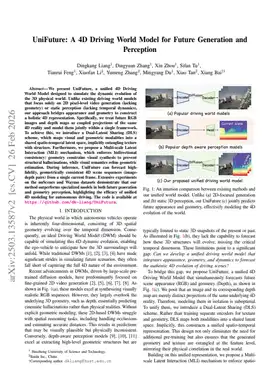
UniFuture: A 4D Driving World Model for Future Generation and Perception
We present UniFuture, a unified 4D Driving World Model designed to simulate the dynamic evolution of the 3D physical world. Unlike existing driving world models that focus solely on 2D pixel-level video generation (lacking geometry) or static perception (lacking temporal dynamics), our approach bridges appearance and geometry to construct a holistic 4D representation. Specifically, we treat future
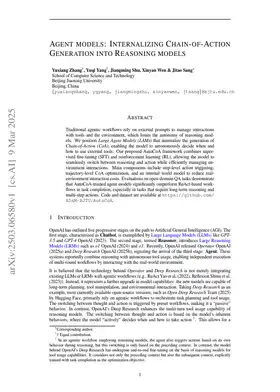
Agent models: Internalizing Chain-of-Action Generation into Reasoning models
Traditional agentic workflows rely on external prompts to manage interactions with tools and the environment, which limits the autonomy of reasoning models. We position \emph{Large Agent Models (LAMs)} that internalize the generation of \emph{Chain-of-Action (CoA)}, enabling the model to autonomously decide when and how to use external tools. Our proposed AutoCoA framework combines supervised fine
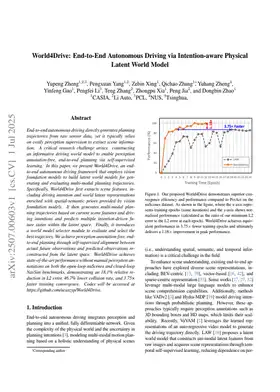
World4Drive: End-to-End Autonomous Driving via Intention-aware Physical Latent World Model
End-to-end autonomous driving directly generates planning trajectories from raw sensor data, yet it typically relies on costly perception supervision to extract scene information. A critical research challenge arises: constructing an informative driving world model to enable perception annotation-free, end-to-end planning via self-supervised learning. In this paper, we present World4Drive, an end-
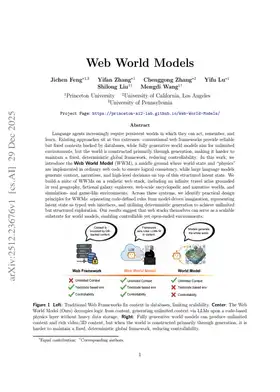
Web World Models
Language agents increasingly require persistent worlds in which they can act, remember, and learn. Existing approaches sit at two extremes: conventional web frameworks provide reliable but fixed contexts backed by databases, while fully generative world models aim for unlimited environments at the expense of controllability and practical engineering. In this work, we introduce the Web World Model
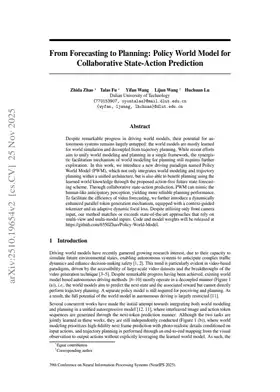
From Forecasting to Planning: Policy World Model for Collaborative State-Action Prediction
Despite remarkable progress in driving world models, their potential for autonomous systems remains largely untapped: the world models are mostly learned for world simulation and decoupled from trajectory planning. While recent efforts aim to unify world modeling and planning in a single framework, the synergistic facilitation mechanism of world modeling for planning still requires further explora
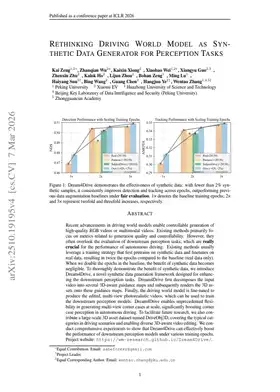
Rethinking Driving World Model as Synthetic Data Generator for Perception Tasks
Recent advancements in driving world models enable controllable generation of high-quality RGB videos or multimodal videos. Existing methods primarily focus on metrics related to generation quality and controllability. However, they often overlook the evaluation of downstream perception tasks, which are $\mathbf{really\ crucial}$ for the performance of autonomous driving. Existing methods usually
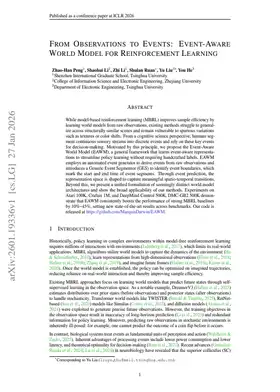
From Observations to Events: Event-Aware World Model for Reinforcement Learning
While model-based reinforcement learning (MBRL) improves sample efficiency by learning world models from raw observations, existing methods struggle to generalize across structurally similar scenes and remain vulnerable to spurious variations such as textures or color shifts. From a cognitive science perspective, humans segment continuous sensory streams into discrete events and rely on these key
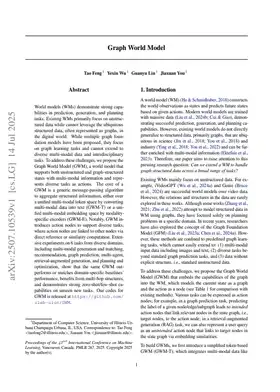
Graph World Model
World models (WMs) demonstrate strong capabilities in prediction, generation, and planning tasks. Existing WMs primarily focus on unstructured data and cannot leverage the ubiquitous structured data, often represented as graphs, in the digital world. While multiple graph foundation models have been proposed, they focus on graph learning tasks and cannot extend to diverse multi-modal data and inter
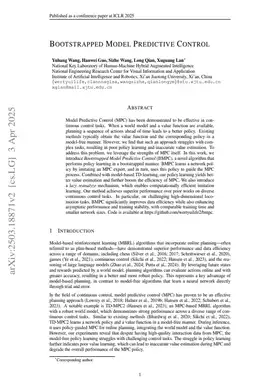
Bootstrapped Model Predictive Control
Model Predictive Control (MPC) has been demonstrated to be effective in continuous control tasks. When a world model and a value function are available, planning a sequence of actions ahead of time leads to a better policy. Existing methods typically obtain the value function and the corresponding policy in a model-free manner. However, we find that such an approach struggles with complex tasks, r
Self-Supervised Multi-Modal World Model with 4D Space-Time Embedding
We present DeepEarth, a self-supervised multi-modal world model with Earth4D, a novel planetary-scale 4D space-time positional encoder. Earth4D extends 3D multi-resolution hash encoding to include time, efficiently scaling across the planet over centuries with sub-meter, sub-second precision. Multi-modal encoders (e.g. vision-language models) are fused with Earth4D embeddings and trained via maske
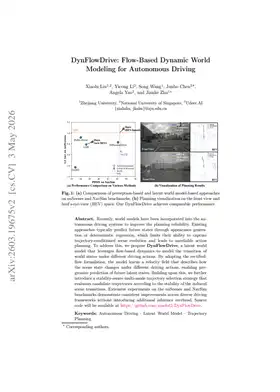
DynFlowDrive: Flow-Based Dynamic World Modeling for Autonomous Driving
Recently, world models have been incorporated into the autonomous driving systems to improve the planning reliability. Existing approaches typically predict future states through appearance generation or deterministic regression, which limits their ability to capture trajectory-conditioned scene evolution and leads to unreliable action planning. To address this, we propose DynFlowDrive, a latent w
Language-Conditioned World Modeling for Visual Navigation
We study language-conditioned visual navigation (LCVN), in which an embodied agent is asked to follow a natural language instruction based only on an initial egocentric observation. Without access to goal images, the agent must rely on language to shape its perception and continuous control, making the grounding problem particularly challenging. We formulate this problem as open-loop trajectory pr
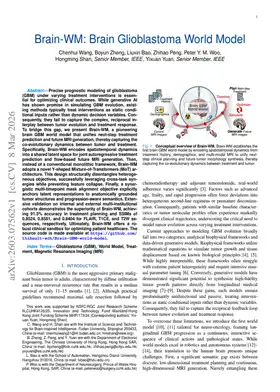
Brain-WM: Brain Glioblastoma World Model
Precise prognostic modeling of glioblastoma (GBM) under varying treatment interventions is essential for optimizing clinical outcomes. While generative AI has shown promise in simulating GBM evolution, existing methods typically treat interventions as static conditional inputs rather than dynamic decision variables. Consequently, they fail to capture the complex, reciprocal interplay between tumor
Revisiting Multi-Agent World Modeling from a Diffusion-Inspired Perspective
World models have recently attracted growing interest in Multi-Agent Reinforcement Learning (MARL) due to their ability to improve sample efficiency for policy learning. However, accurately modeling environments in MARL is challenging due to the exponentially large joint action space and highly uncertain dynamics inherent in multi-agent systems. To address this, we reduce modeling complexity by sh