
HiDream-I1: A High-Efficient Image Generative Foundation Model with Sparse Diffusion Transformer
Recent advancements in image generative foundation models have prioritized quality improvements but often at the cost of increased computational complexity and inference latency. To address this critical trade-off, we introduce HiDream-I1, a new open-source image generative foundation model with 17B parameters that achieves state-of-the-art image generation quality within seconds. HiDream-I1 is co
MMaDA: Multimodal Large Diffusion Language Models
We introduce MMaDA, a novel class of multimodal diffusion foundation models designed to achieve superior performance across diverse domains such as textual reasoning, multimodal understanding, and text-to-image generation. The approach is distinguished by three key innovations: (i) MMaDA adopts a unified diffusion architecture with a shared probabilistic formulation and a modality-agnostic design,
Emu3.5: Native Multimodal Models are World Learners
We introduce Emu3.5, a large-scale multimodal world model that natively predicts the next state across vision and language. Emu3.5 is pre-trained end-to-end with a unified next-token prediction objective on a corpus of vision-language interleaved data containing over 10 trillion tokens, primarily derived from sequential frames and transcripts of internet videos. The model naturally accepts interle
dMLLM-TTS: Self-Verified and Efficient Test-Time Scaling for Diffusion Multi-Modal Large Language Models
Diffusion Multi-modal Large Language Models (dMLLMs) have recently emerged as a novel architecture unifying image generation and understanding. However, developing effective and efficient Test-Time Scaling (TTS) methods to unlock their full generative potential remains an underexplored challenge. To address this, we propose dMLLM-TTS, a novel framework operating on two complementary scaling axes:
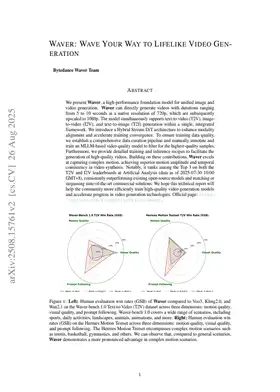
Waver: Wave Your Way to Lifelike Video Generation
We present Waver, a high-performance foundation model for unified image and video generation. Waver can directly generate videos with durations ranging from 5 to 10 seconds at a native resolution of 720p, which are subsequently upscaled to 1080p. The model simultaneously supports text-to-video (T2V), image-to-video (I2V), and text-to-image (T2I) generation within a single, integrated framework. We
Delving into RL for Image Generation with CoT: A Study on DPO vs. GRPO
Recent advancements underscore the significant role of Reinforcement Learning (RL) in enhancing the Chain-of-Thought (CoT) reasoning capabilities of large language models (LLMs). Two prominent RL algorithms, Direct Preference Optimization (DPO) and Group Relative Policy Optimization (GRPO), are central to these developments, showcasing different pros and cons. Autoregressive image generation, also
Can We Generate Images with CoT? Let's Verify and Reinforce Image Generation Step by Step
Chain-of-Thought (CoT) reasoning has been extensively explored in large models to tackle complex understanding tasks. However, it still remains an open question whether such strategies can be applied to verifying and reinforcing image generation scenarios. In this paper, we provide the first comprehensive investigation of the potential of CoT reasoning to enhance autoregressive image generation. W
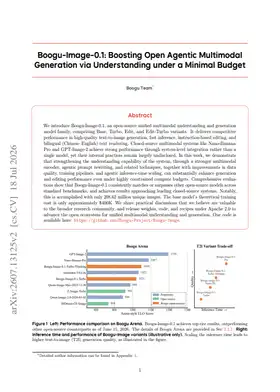
Boogu-Image-0.1: Boosting Open Agentic Multimodal Generation via Understanding under a Minimal Budget
We introduce Boogu-Image-0.1, an open-source unified multimodal understanding and generation model family, comprising Base, Turbo, Edit, and Edit-Turbo variants. It delivers competitive performance in high-quality text-to-image generation, fast inference, instruction-based editing, and bilingual (Chinese-English) text rendering. Closed-source multimodal systems like Nano-Banana-Pro and GPT-Image-2
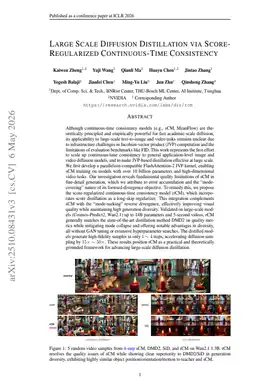
Large Scale Diffusion Distillation via Score-Regularized Continuous-Time Consistency
Although continuous-time consistency models (e.g., sCM, MeanFlow) are theoretically principled and empirically powerful for fast academic-scale diffusion, its applicability to large-scale text-to-image and video tasks remains unclear due to infrastructure challenges in Jacobian-vector product (JVP) computation and the limitations of evaluation benchmarks like FID. This work represents the first ef
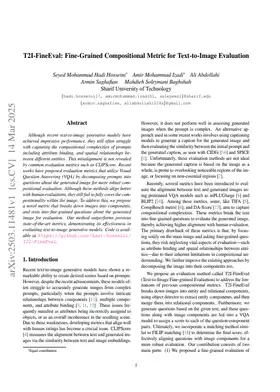
T2I-FineEval: Fine-Grained Compositional Metric for Text-to-Image Evaluation
Although recent text-to-image generative models have achieved impressive performance, they still often struggle with capturing the compositional complexities of prompts including attribute binding, and spatial relationships between different entities. This misalignment is not revealed by common evaluation metrics such as CLIPScore. Recent works have proposed evaluation metrics that utilize Visual
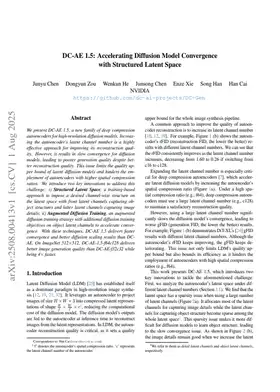
DC-AE 1.5: Accelerating Diffusion Model Convergence with Structured Latent Space
We present DC-AE 1.5, a new family of deep compression autoencoders for high-resolution diffusion models. Increasing the autoencoder's latent channel number is a highly effective approach for improving its reconstruction quality. However, it results in slow convergence for diffusion models, leading to poorer generation quality despite better reconstruction quality. This issue limits the quality up
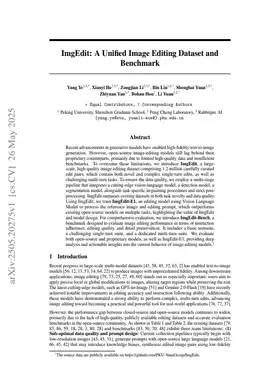
ImgEdit: A Unified Image Editing Dataset and Benchmark
Recent advancements in generative models have enabled high-fidelity text-to-image generation. However, open-source image-editing models still lag behind their proprietary counterparts, primarily due to limited high-quality data and insufficient benchmarks. To overcome these limitations, we introduce ImgEdit, a large-scale, high-quality image-editing dataset comprising 1.2 million carefully curated
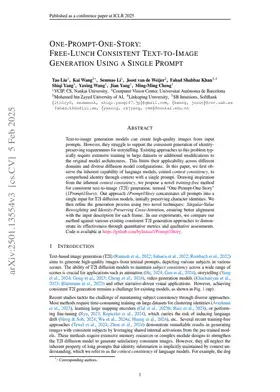
One-Prompt-One-Story: Free-Lunch Consistent Text-to-Image Generation Using a Single Prompt
Text-to-image generation models can create high-quality images from input prompts. However, they struggle to support the consistent generation of identity-preserving requirements for storytelling. Existing approaches to this problem typically require extensive training in large datasets or additional modifications to the original model architectures. This limits their applicability across differen
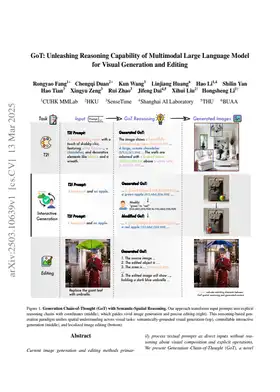
GoT: Unleashing Reasoning Capability of Multimodal Large Language Model for Visual Generation and Editing
Current image generation and editing methods primarily process textual prompts as direct inputs without reasoning about visual composition and explicit operations. We present Generation Chain-of-Thought (GoT), a novel paradigm that enables generation and editing through an explicit language reasoning process before outputting images. This approach transforms conventional text-to-image generation a
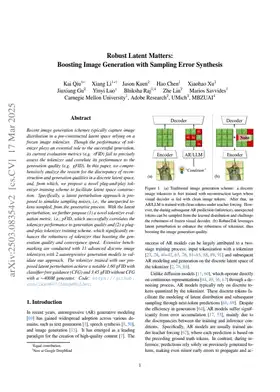
Robust Latent Matters: Boosting Image Generation with Sampling Error Synthesis
Recent image generation schemes typically capture image distribution in a pre-constructed latent space relying on a frozen image tokenizer. Though the performance of tokenizer plays an essential role to the successful generation, its current evaluation metrics (e.g. rFID) fail to precisely assess the tokenizer and correlate its performance to the generation quality (e.g. gFID). In this paper, we c
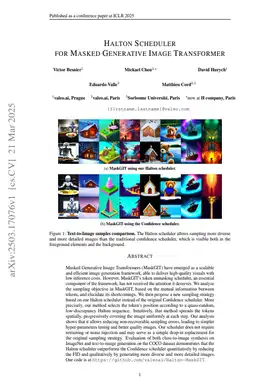
Halton Scheduler For Masked Generative Image Transformer
Masked Generative Image Transformers (MaskGIT) have emerged as a scalable and efficient image generation framework, able to deliver high-quality visuals with low inference costs. However, MaskGIT's token unmasking scheduler, an essential component of the framework, has not received the attention it deserves. We analyze the sampling objective in MaskGIT, based on the mutual information between toke
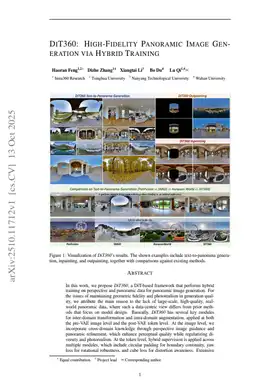
DiT360: High-Fidelity Panoramic Image Generation via Hybrid Training
In this work, we propose DiT360, a DiT-based framework that performs hybrid training on perspective and panoramic data for panoramic image generation. For the issues of maintaining geometric fidelity and photorealism in generation quality, we attribute the main reason to the lack of large-scale, high-quality, real-world panoramic data, where such a data-centric view differs from prior methods that
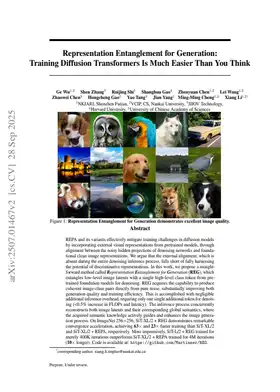
Representation Entanglement for Generation: Training Diffusion Transformers Is Much Easier Than You Think
REPA and its variants effectively mitigate training challenges in diffusion models by incorporating external visual representations from pretrained models, through alignment between the noisy hidden projections of denoising networks and foundational clean image representations. We argue that the external alignment, which is absent during the entire denoising inference process, falls short of fully
OCRGenBench: A Comprehensive Benchmark for Evaluating OCR Generative Capabilities
Improving visual text synthesis has long been a challenging and evolving frontier for image generation models. While recent state-of-the-art (SOTA) models have made remarkable strides in text generation capabilities, existing benchmarks inadequately assess their true performance due to narrow scope (scene text and posters only), isolated evaluation (T2I generation or editing separately), and insuf
FreeFuse: Multi-Subject LoRA Fusion via Adaptive Token-Level Routing at Test Time
This paper proposes FreeFuse, a training-free framework for multi-subject text-to-image generation through automatic fusion of multiple subject LoRAs. In contrast to prior studies that focus on retraining LoRA to alleviate feature conflicts, our analysis reveals that simply spatially confining the subject LoRA's output to its target region and preventing other LoRAs from directly intruding into th
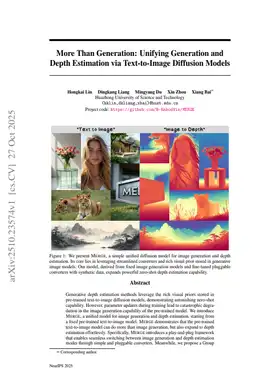
More Than Generation: Unifying Generation and Depth Estimation via Text-to-Image Diffusion Models
Generative depth estimation methods leverage the rich visual priors stored in pre-trained text-to-image diffusion models, demonstrating astonishing zero-shot capability. However, parameter updates during training lead to catastrophic degradation in the image generation capability of the pre-trained model. We introduce MERGE, a unified model for image generation and depth estimation, starting from
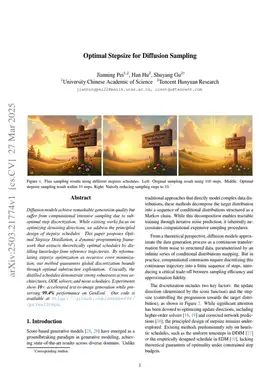
Optimal Stepsize for Diffusion Sampling
Diffusion models achieve remarkable generation quality but suffer from computational intensive sampling due to suboptimal step discretization. While existing works focus on optimizing denoising directions, we address the principled design of stepsize schedules. This paper proposes Optimal Stepsize Distillation, a dynamic programming framework that extracts theoretically optimal schedules by distil
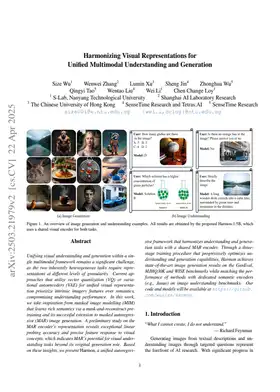
Harmonizing Visual Representations for Unified Multimodal Understanding and Generation
Unifying visual understanding and generation within a single multimodal framework remains a significant challenge, as the two inherently heterogeneous tasks require representations at different levels of granularity. Current approaches that utilize vector quantization (VQ) or variational autoencoders (VAE) for unified visual representation prioritize intrinsic imagery features over semantics, comp
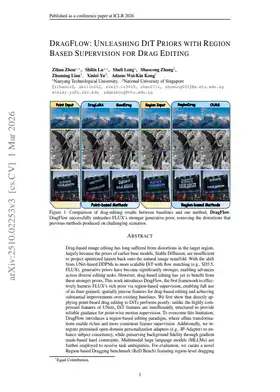
DragFlow: Unleashing DiT Priors with Region Based Supervision for Drag Editing
Drag-based image editing has long suffered from distortions in the target region, largely because the priors of earlier base models, Stable Diffusion, are insufficient to project optimized latents back onto the natural image manifold. With the shift from UNet-based DDPMs to more scalable DiT with flow matching (e.g., SD3.5, FLUX), generative priors have become significantly stronger, enabling adva
Competition and Attraction Improve Model Fusion
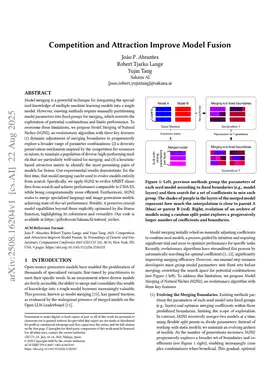
Model merging is a powerful technique for integrating the specialized knowledge of multiple machine learning models into a single model. However, existing methods require manually partitioning model parameters into fixed groups for merging, which restricts the exploration of potential combinations and limits performance. To overcome these limitations, we propose Model Merging of Natural Niches (M2