
Trae Agent: An LLM-based Agent for Software Engineering with Test-time Scaling
Software issue resolution is a critical challenge in software engineering and has garnered increasing attention in recent years. With the rapid advancement of large language models (LLMs), substantial progress has been made in addressing real-world software engineering tasks. Recent studies have introduced ensemble reasoning techniques to enhance the performance of LLM-based issue resolution. Howe
GLM-4.5: Agentic, Reasoning, and Coding (ARC) Foundation Models
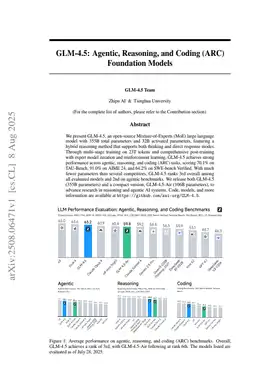
We present GLM-4.5, an open-source Mixture-of-Experts (MoE) large language model with 355B total parameters and 32B activated parameters, featuring a hybrid reasoning method that supports both thinking and direct response modes. Through multi-stage training on 23T tokens and comprehensive post-training with expert model iteration and reinforcement learning, GLM-4.5 achieves strong performance acro
Marco-o1 v2: Towards Widening The Distillation Bottleneck for Reasoning Models
Large Reasoning Models(LRMs) such as OpenAI o1 and DeepSeek-R1 have shown remarkable reasoning capabilities by scaling test-time compute and generating long Chain-of-Thought(CoT). Distillation--post-training on LRMs-generated data--is a straightforward yet effective method to enhance the reasoning abilities of smaller models, but faces a critical bottleneck: we found that distilled long CoT data p
FlowSearch: Advancing deep research with dynamic structured knowledge flow
Deep research is an inherently challenging task that demands both breadth and depth of thinking. It involves navigating diverse knowledge spaces and reasoning over complex, multi-step dependencies, which presents substantial challenges for agentic systems. To address this, we propose FlowSearch, a multi-agent framework that actively constructs and evolves a dynamic structured knowledge flow to dri
dInfer: An Efficient Inference Framework for Diffusion Language Models
Diffusion-based large language models (dLLMs) have emerged as a promising alternative to autoregressive (AR) LLMs, leveraging denoising-based generation to enable inherent parallelism. Even more and more open-sourced dLLM models emerge, yet their widespread adoption remains constrained by the lack of a standardized and efficient inference framework. We present dInfer, an efficient and extensible f
Huxley-Gödel Machine: Human-Level Coding Agent Development by an Approximation of the Optimal Self-Improving Machine
Recent studies operationalize self-improvement through coding agents that edit their own codebases. They grow a tree of self-modifications through expansion strategies that favor higher software engineering benchmark performance, assuming that this implies more promising subsequent self-modifications. However, we identify a mismatch between the agent's self-improvement potential (metaproductivity)
Decoder-Hybrid-Decoder Architecture for Efficient Reasoning with Long Generation
Recent advances in language modeling have demonstrated the effectiveness of State Space Models (SSMs) for efficient sequence modeling. While hybrid architectures such as Samba and the decoder-decoder architecture, YOCO, have shown promising performance gains over Transformers, prior works have not investigated the efficiency potential of representation sharing between SSM layers. In this paper, we
UltraEval-Audio: A Unified Framework for Comprehensive Evaluation of Audio Foundation Models
The development of audio foundation models has accelerated rapidly since the emergence of GPT-4o. However, the lack of comprehensive evaluation has become a critical bottleneck for further progress in the field, particularly in audio generation. Current audio evaluation faces three major challenges: (1) audio evaluation lacks a unified framework, with datasets and code scattered across various sou
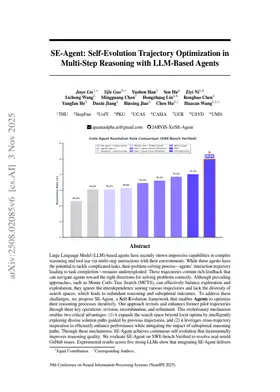
SE-Agent: Self-Evolution Trajectory Optimization in Multi-Step Reasoning with LLM-Based Agents
Large Language Model (LLM)-based agents have recently shown impressive capabilities in complex reasoning and tool use via multi-step interactions with their environments. While these agents have the potential to tackle complicated tasks, their problem-solving process, i.e., agents' interaction trajectory leading to task completion, remains underexploited. These trajectories contain rich feedback t
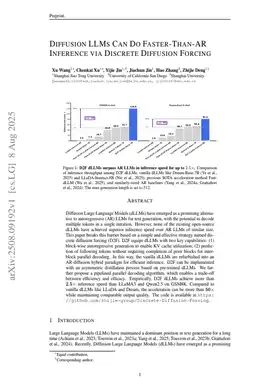
Diffusion LLMs Can Do Faster-Than-AR Inference via Discrete Diffusion Forcing
Diffusion Large Language Models (dLLMs) have emerged as a promising alternative to autoregressive (AR) LLMs for text generation, with the potential to decode multiple tokens in a single iteration. However, none of the existing open-source dLLMs have achieved superior inference speed over AR LLMs of similar size. This paper breaks this barrier based on a simple and effective strategy named discrete
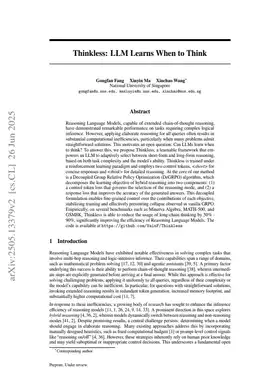
Thinkless: LLM Learns When to Think
Reasoning Language Models, capable of extended chain-of-thought reasoning, have demonstrated remarkable performance on tasks requiring complex logical inference. However, applying elaborate reasoning for all queries often results in substantial computational inefficiencies, particularly when many problems admit straightforward solutions. This motivates an open question: Can LLMs learn when to thin
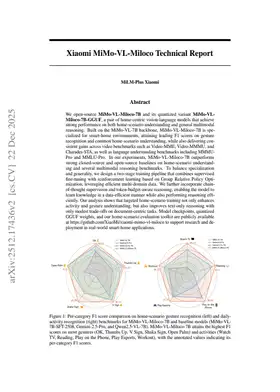
Xiaomi MiMo-VL-Miloco Technical Report
We open-source MiMo-VL-Miloco-7B and its quantized variant MiMo-VL-Miloco-7B-GGUF, a pair of home-centric vision-language models that achieve strong performance on both home-scenario understanding and general multimodal reasoning. Built on the MiMo-VL-7B backbone, MiMo-VL-Miloco-7B is specialized for smart-home environments, attaining leading F1 scores on gesture recognition and common home-scenar
Rethinking LLM-as-a-Judge: Representation-as-a-Judge with Small Language Models via Semantic Capacity Asymmetry
Large language models (LLMs) are widely used as reference-free evaluators via prompting, but this "LLM-as-a-Judge" paradigm is costly, opaque, and sensitive to prompt design. In this work, we investigate whether smaller models can serve as efficient evaluators by leveraging internal representations instead of surface generation. We uncover a consistent empirical pattern: small LMs, despite with we
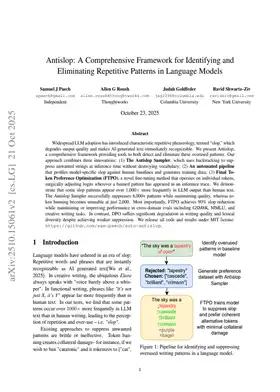
Antislop: A Comprehensive Framework for Identifying and Eliminating Repetitive Patterns in Language Models
Widespread LLM adoption has introduced characteristic repetitive phraseology, termed "slop," which degrades output quality and makes AI-generated text immediately recognizable. We present Antislop, a comprehensive framework providing tools to both detect and eliminate these overused patterns. Our approach combines three innovations: (1) The Antislop Sampler, which uses backtracking to suppress unw
UR$^2$: Unify RAG and Reasoning through Reinforcement Learning
Large Language Models (LLMs) have shown strong capabilities through two complementary paradigms: Retrieval-Augmented Generation (RAG) for knowledge grounding and Reinforcement Learning from Verifiable Rewards (RLVR) for complex reasoning. However, existing attempts to unify these paradigms remain narrow in scope, typically limited to open-domain QA with fixed retrieval settings, which constrains g
Fast and Accurate Causal Parallel Decoding using Jacobi Forcing
Multi-token generation has emerged as a promising paradigm for accelerating transformer-based large model inference. Recent efforts primarily explore diffusion Large Language Models (dLLMs) for parallel decoding to reduce inference latency. To achieve AR-level generation quality, many techniques adapt AR models into dLLMs to enable parallel decoding. However, they suffer from limited speedup compa
Synthetic Data RL: Task Definition Is All You Need
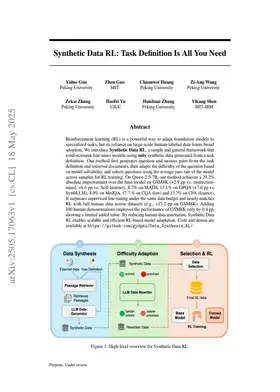
Reinforcement learning (RL) is a powerful way to adapt foundation models to specialized tasks, but its reliance on large-scale human-labeled data limits broad adoption. We introduce Synthetic Data RL, a simple and general framework that reinforcement fine-tunes models using only synthetic data generated from a task definition. Our method first generates question and answer pairs from the task defi
SLOT: Sample-specific Language Model Optimization at Test-time
We propose SLOT (Sample-specific Language Model Optimization at Test-time), a novel and parameter-efficient test-time inference approach that enhances a language model's ability to more accurately respond to individual prompts. Existing Large Language Models (LLMs) often struggle with complex instructions, leading to poor performances on those not well represented among general samples. To address
Reinforcing General Reasoning without Verifiers
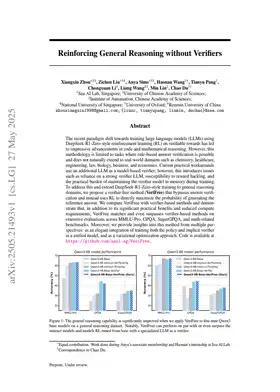
The recent paradigm shift towards training large language models (LLMs) using DeepSeek-R1-Zero-style reinforcement learning (RL) on verifiable rewards has led to impressive advancements in code and mathematical reasoning. However, this methodology is limited to tasks where rule-based answer verification is possible and does not naturally extend to real-world domains such as chemistry, healthcare,
Chain-of-Tools: Utilizing Massive Unseen Tools in the CoT Reasoning of Frozen Language Models
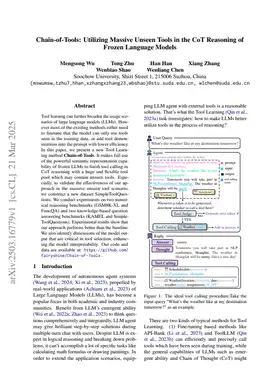
Tool learning can further broaden the usage scenarios of large language models (LLMs). However most of the existing methods either need to finetune that the model can only use tools seen in the training data, or add tool demonstrations into the prompt with lower efficiency. In this paper, we present a new Tool Learning method Chain-of-Tools. It makes full use of the powerful semantic representatio
Advances and Frontiers of LLM-based Issue Resolution in Software Engineering: A Comprehensive Survey
Issue resolution, a complex Software Engineering (SWE) task integral to real-world development, has emerged as a compelling challenge for artificial intelligence. The establishment of benchmarks like SWE-bench revealed this task as profoundly difficult for large language models, thereby significantly accelerating the evolution of autonomous coding agents. This paper presents a systematic survey of
The Rise of AI Teammates in Software Engineering (SE) 3.0: How Autonomous Coding Agents Are Reshaping Software Engineering
The future of software engineering--SE 3.0--is unfolding with the rise of AI teammates: autonomous, goal-driven systems collaborating with human developers. Among these, autonomous coding agents are especially transformative, now actively initiating, reviewing, and evolving code at scale. This paper introduces AIDev, the first large-scale dataset capturing how such agents operate in the wild. Span
Agentar-Fin-R1: Enhancing Financial Intelligence through Domain Expertise, Training Efficiency, and Advanced Reasoning
Large Language Models (LLMs) exhibit considerable promise in financial applications; however, prevailing models frequently demonstrate limitations when confronted with scenarios that necessitate sophisticated reasoning capabilities, stringent trustworthiness criteria, and efficient adaptation to domain-specific requirements. We introduce the Agentar-Fin-R1 series of financial large language models
Quamba2: A Robust and Scalable Post-training Quantization Framework for Selective State Space Models
State Space Models (SSMs) are emerging as a compelling alternative to Transformers because of their consistent memory usage and high performance. Despite this, scaling up SSMs on cloud services or limited-resource devices is challenging due to their storage requirements and computational power. To overcome this, quantizing SSMs with low bit-width data formats can reduce model size and benefit from
TruthTorchLM: A Comprehensive Library for Predicting Truthfulness in LLM Outputs
Generative Large Language Models (LLMs)inevitably produce untruthful responses. Accurately predicting the truthfulness of these outputs is critical, especially in high-stakes settings. To accelerate research in this domain and make truthfulness prediction methods more accessible, we introduce TruthTorchLM an open-source, comprehensive Python library featuring over 30 truthfulness prediction method