

Multi-Agent Collaboration via Evolving Orchestration
Large language models (LLMs) have achieved remarkable results across diverse downstream tasks, but their monolithic nature restricts scalability and efficiency in complex problem-solving. While recent research explores multi-agent collaboration among LLMs, most approaches rely on static organizational structures that struggle to adapt as task complexity and agent numbers grow, resulting in coordin
WebDancer: Towards Autonomous Information Seeking Agency
Addressing intricate real-world problems necessitates in-depth information seeking and multi-step reasoning. Recent progress in agentic systems, exemplified by Deep Research, underscores the potential for autonomous multi-step research. In this work, we present a cohesive paradigm for building end-to-end agentic information seeking agents from a data-centric and training-stage perspective. Our app

AI-native Memory 2.0: Second Me
Human interaction with the external world fundamentally involves the exchange of personal memory, whether with other individuals, websites, applications, or, in the future, AI agents. A significant portion of this interaction is redundant, requiring users to repeatedly provide the same information across different contexts. Existing solutions, such as browser-stored credentials, autofill mechanism
R&D-Agent-Quant: A Multi-Agent Framework for Data-Centric Factors and Model Joint Optimization
Financial markets pose fundamental challenges for asset return prediction due to their high dimensionality, non-stationarity, and persistent volatility. Despite advances in large language models and multi-agent systems, current quantitative research pipelines suffer from limited automation, weak interpretability, and fragmented coordination across key components such as factor mining and model inn
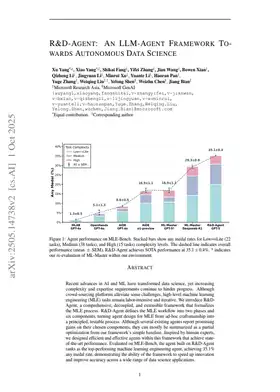
R&D-Agent: An LLM-Agent Framework Towards Autonomous Data Science
Recent advances in AI and ML have transformed data science, yet increasing complexity and expertise requirements continue to hinder progress. Although crowd-sourcing platforms alleviate some challenges, high-level machine learning engineering (MLE) tasks remain labor-intensive and iterative. We introduce R&D-Agent, a comprehensive, decoupled, and extensible framework that formalizes the MLE proces
AutoResearchClaw: Self-Reinforcing Autonomous Research with Human-AI Collaboration
Automating scientific discovery requires more than generating papers from ideas. Real research is iterative: hypotheses are challenged from multiple perspectives, experiments fail and inform the next attempt, and lessons accumulate across cycles. Existing autonomous research systems often model this process as a linear pipeline: they rely on single-agent reasoning, stop when execution fails, and d
Trae Agent: An LLM-based Agent for Software Engineering with Test-time Scaling
Software issue resolution is a critical challenge in software engineering and has garnered increasing attention in recent years. With the rapid advancement of large language models (LLMs), substantial progress has been made in addressing real-world software engineering tasks. Recent studies have introduced ensemble reasoning techniques to enhance the performance of LLM-based issue resolution. Howe
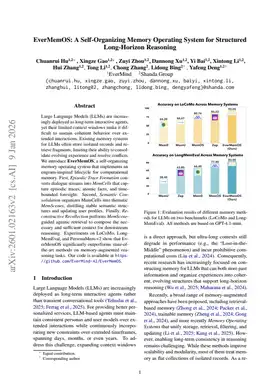
EverMemOS: A Self-Organizing Memory Operating System for Structured Long-Horizon Reasoning
Large Language Models (LLMs) are increasingly deployed as long-term interactive agents, yet their limited context windows make it difficult to sustain coherent behavior over extended interactions. Existing memory systems often store isolated records and retrieve fragments, limiting their ability to consolidate evolving user states and resolve conflicts. We introduce EverMemOS, a self-organizing me
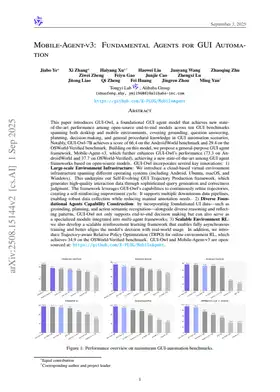
Mobile-Agent-v3: Fundamental Agents for GUI Automation
This paper introduces GUI-Owl, a foundational GUI agent model that achieves state-of-the-art performance among open-source end-to-end models on ten GUI benchmarks across desktop and mobile environments, covering grounding, question answering, planning, decision-making, and procedural knowledge. GUI-Owl-7B achieves 66.4 on AndroidWorld and 29.4 on OSWorld. Building on this, we propose Mobile-Agent-
TinyTroupe: An LLM-powered Multiagent Persona Simulation Toolkit
Recent advances in Large Language Models (LLM) have led to a new class of autonomous agents, renewing and expanding interest in the area. LLM-powered Multiagent Systems (MAS) have thus emerged, both for assistive and simulation purposes, yet tools for realistic human behavior simulation -- with its distinctive challenges and opportunities -- remain underdeveloped. Existing MAS libraries and tools
An Empirical Study on Reinforcement Learning for Reasoning-Search Interleaved LLM Agents
Reinforcement learning (RL) has demonstrated strong potential in training large language models (LLMs) capable of complex reasoning for real-world problem solving. More recently, RL has been leveraged to create sophisticated LLM-based search agents that adeptly combine reasoning with search engine use. While the use of RL for training search agents is promising, the optimal design of such agents r
Adaptive Vision-Language Model Routing for Computer Use Agents
Computer Use Agents (CUAs) translate natural-language instructions into Graphical User Interface (GUI) actions such as clicks, keystrokes, and scrolls by relying on a Vision-Language Model (VLM) to interpret screenshots and predict grounded tool calls. However, grounding accuracy varies dramatically across VLMs, while current CUA systems typically route every action to a single fixed model regardl
Visual Confused Deputy: Exploiting and Defending Perception Failures in Computer-Using Agents
Computer-using agents (CUAs) act directly on graphical user interfaces, yet their perception of the screen is often unreliable. Existing work largely treats these failures as performance limitations, asking whether an action succeeds, rather than whether the agent is acting on the correct object at all. We argue that this is fundamentally a security problem. We formalize the visual confused deputy
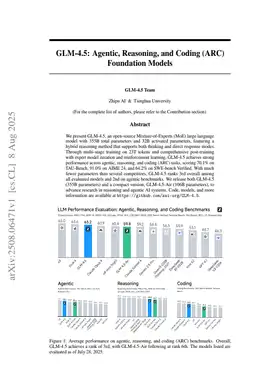
GLM-4.5: Agentic, Reasoning, and Coding (ARC) Foundation Models
We present GLM-4.5, an open-source Mixture-of-Experts (MoE) large language model with 355B total parameters and 32B activated parameters, featuring a hybrid reasoning method that supports both thinking and direct response modes. Through multi-stage training on 23T tokens and comprehensive post-training with expert model iteration and reinforcement learning, GLM-4.5 achieves strong performance acro
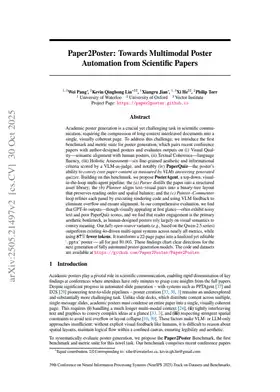
Paper2Poster: Towards Multimodal Poster Automation from Scientific Papers
Academic poster generation is a crucial yet challenging task in scientific communication, requiring the compression of long-context interleaved documents into a single, visually coherent page. To address this challenge, we introduce the first benchmark and metric suite for poster generation, which pairs recent conference papers with author-designed posters and evaluates outputs on (i)Visual Qualit
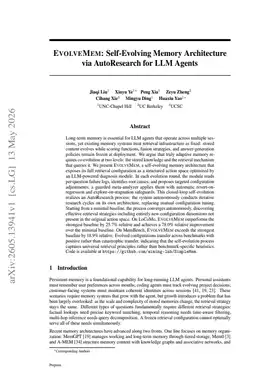
EvolveMem:Self-Evolving Memory Architecture via AutoResearch for LLM Agents
Long-term memory is essential for LLM agents that operate across multiple sessions, yet existing memory systems treat retrieval infrastructure as fixed: stored content evolves while scoring functions, fusion strategies, and answer-generation policies remain frozen at deployment. We argue that truly adaptive memory requires co-evolution at two levels: the stored knowledge and the retrieval mechanis
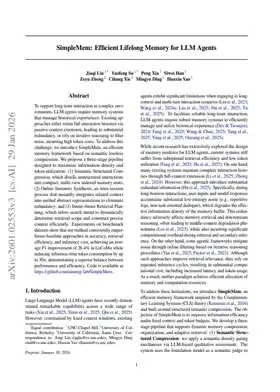
SimpleMem: Efficient Lifelong Memory for LLM Agents
To support long-term interaction in complex environments, LLM agents require memory systems that manage historical experiences. Existing approaches either retain full interaction histories via passive context extension, leading to substantial redundancy, or rely on iterative reasoning to filter noise, incurring high token costs. To address this challenge, we introduce SimpleMem, an efficient memor
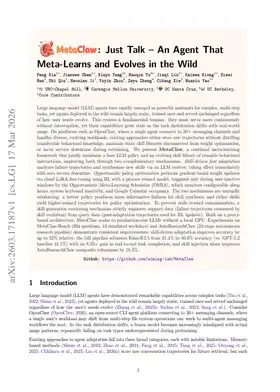
MetaClaw: Just Talk -- An Agent That Meta-Learns and Evolves in the Wild
Large language model (LLM) agents are increasingly used for complex tasks, yet deployed agents often remain static, failing to adapt as user needs evolve. This creates a tension between the need for continuous service and the necessity of updating capabilities to match shifting task distributions. On platforms like OpenClaw, which handle diverse workloads across 20+ channels, existing methods eith
EvoAgentX: An Automated Framework for Evolving Agentic Workflows
Multi-agent systems (MAS) have emerged as a powerful paradigm for orchestrating large language models (LLMs) and specialized tools to collaboratively address complex tasks. However, existing MAS frameworks often require manual workflow configuration and lack native support for dynamic evolution and performance optimization. In addition, many MAS optimization algorithms are not integrated into a un
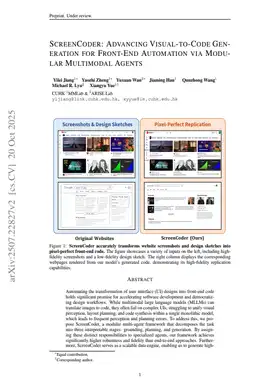
ScreenCoder: Advancing Visual-to-Code Generation for Front-End Automation via Modular Multimodal Agents
Automating the transformation of user interface (UI) designs into front-end code holds significant promise for accelerating software development and democratizing design workflows. While multimodal large language models (MLLMs) can translate images to code, they often fail on complex UIs, struggling to unify visual perception, layout planning, and code synthesis within a single monolithic model, w
Large Language Model Agent: A Survey on Methodology, Applications and Challenges
The era of intelligent agents is upon us, driven by revolutionary advancements in large language models. Large Language Model (LLM) agents, with goal-driven behaviors and dynamic adaptation capabilities, potentially represent a critical pathway toward artificial general intelligence. This survey systematically deconstructs LLM agent systems through a methodology-centered taxonomy, linking architec
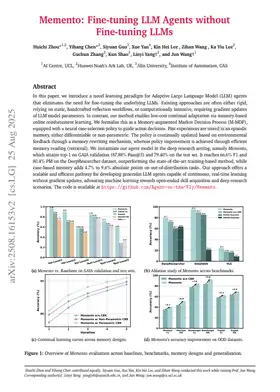
Memento: Fine-tuning LLM Agents without Fine-tuning LLMs
In this paper, we introduce a novel learning paradigm for Adaptive Large Language Model (LLM) agents that eliminates the need for fine-tuning the underlying LLMs. Existing approaches are often either rigid, relying on static, handcrafted reflection workflows, or computationally intensive, requiring gradient updates of LLM model parameters. In contrast, our method enables low-cost continual adaptat
HiDream-I1: A High-Efficient Image Generative Foundation Model with Sparse Diffusion Transformer
Recent advancements in image generative foundation models have prioritized quality improvements but often at the cost of increased computational complexity and inference latency. To address this critical trade-off, we introduce HiDream-I1, a new open-source image generative foundation model with 17B parameters that achieves state-of-the-art image generation quality within seconds. HiDream-I1 is co
GLM-4.5V and GLM-4.1V-Thinking: Towards Versatile Multimodal Reasoning with Scalable Reinforcement Learning
We present GLM-4.1V-Thinking, GLM-4.5V, and GLM-4.6V, a family of vision-language models (VLMs) designed to advance general-purpose multimodal understanding and reasoning. In this report, we share our key findings in the development of the reasoning-centric training framework. We first develop a capable vision foundation model with significant potential through large-scale pre-training, which argu
Paper2Video: Automatic Video Generation from Scientific Papers
Academic presentation videos have become an essential medium for research communication, yet producing them remains highly labor-intensive, often requiring hours of slide design, recording, and editing for a short 2 to 10 minutes video. Unlike natural video, presentation video generation involves distinctive challenges: inputs from research papers, dense multi-modal information (text, figures, tab