
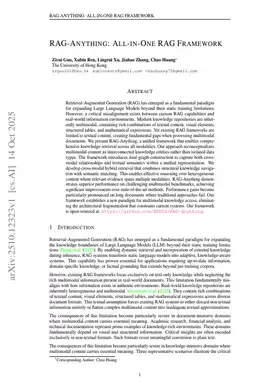
RAG-Anything: All-in-One RAG Framework
Retrieval-Augmented Generation (RAG) has emerged as a fundamental paradigm for expanding Large Language Models beyond their static training limitations. However, a critical misalignment exists between current RAG capabilities and real-world information environments. Modern knowledge repositories are inherently multimodal, containing rich combinations of textual content, visual elements, structured
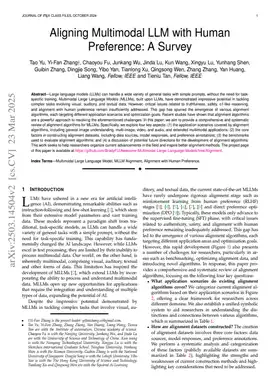
Aligning Multimodal LLM with Human Preference: A Survey
Large language models (LLMs) can handle a wide variety of general tasks with simple prompts, without the need for task-specific training. Multimodal Large Language Models (MLLMs), built upon LLMs, have demonstrated impressive potential in tackling complex tasks involving visual, auditory, and textual data. However, critical issues related to truthfulness, safety, o1-like reasoning, and alignment w
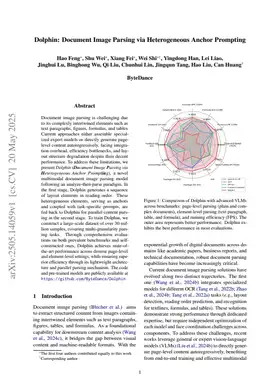
Dolphin: Document Image Parsing via Heterogeneous Anchor Prompting
Document image parsing is challenging due to its complexly intertwined elements such as text paragraphs, figures, formulas, and tables. Current approaches either assemble specialized expert models or directly generate page-level content autoregressively, facing integration overhead, efficiency bottlenecks, and layout structure degradation despite their decent performance. To address these limitati
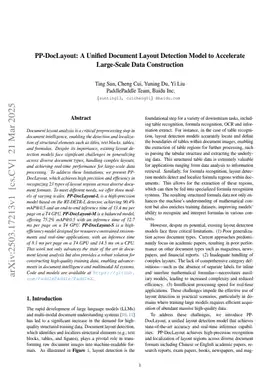
PP-DocLayout: A Unified Document Layout Detection Model to Accelerate Large-Scale Data Construction
Document layout analysis is a critical preprocessing step in document intelligence, enabling the detection and localization of structural elements such as titles, text blocks, tables, and formulas. Despite its importance, existing layout detection models face significant challenges in generalizing across diverse document types, handling complex layouts, and achieving real-time performance for larg
Adaptive Vision-Language Model Routing for Computer Use Agents
Computer Use Agents (CUAs) translate natural-language instructions into Graphical User Interface (GUI) actions such as clicks, keystrokes, and scrolls by relying on a Vision-Language Model (VLM) to interpret screenshots and predict grounded tool calls. However, grounding accuracy varies dramatically across VLMs, while current CUA systems typically route every action to a single fixed model regardl
SAM Audio Judge: A Unified Multimodal Framework for Perceptual Evaluation of Audio Separation
The performance evaluation remains a complex challenge in audio separation, and existing evaluation metrics are often misaligned with human perception, course-grained, relying on ground truth signals. On the other hand, subjective listening tests remain the gold standard for real-world evaluation, but they are expensive, time-consuming, and difficult to scale. This paper addresses the growing need
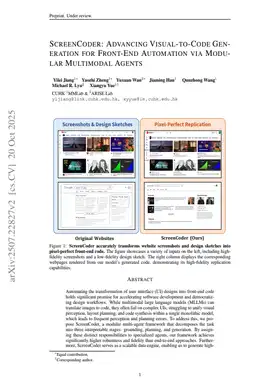
ScreenCoder: Advancing Visual-to-Code Generation for Front-End Automation via Modular Multimodal Agents
Automating the transformation of user interface (UI) designs into front-end code holds significant promise for accelerating software development and democratizing design workflows. While multimodal large language models (MLLMs) can translate images to code, they often fail on complex UIs, struggling to unify visual perception, layout planning, and code synthesis within a single monolithic model, w
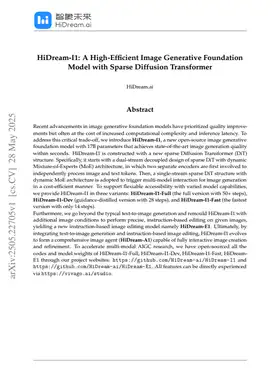
HiDream-I1: A High-Efficient Image Generative Foundation Model with Sparse Diffusion Transformer
Recent advancements in image generative foundation models have prioritized quality improvements but often at the cost of increased computational complexity and inference latency. To address this critical trade-off, we introduce HiDream-I1, a new open-source image generative foundation model with 17B parameters that achieves state-of-the-art image generation quality within seconds. HiDream-I1 is co
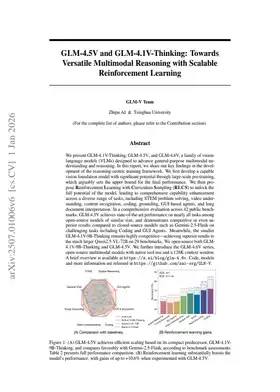
GLM-4.5V and GLM-4.1V-Thinking: Towards Versatile Multimodal Reasoning with Scalable Reinforcement Learning
We present GLM-4.1V-Thinking, GLM-4.5V, and GLM-4.6V, a family of vision-language models (VLMs) designed to advance general-purpose multimodal understanding and reasoning. In this report, we share our key findings in the development of the reasoning-centric training framework. We first develop a capable vision foundation model with significant potential through large-scale pre-training, which argu
Paper2Video: Automatic Video Generation from Scientific Papers
Academic presentation videos have become an essential medium for research communication, yet producing them remains highly labor-intensive, often requiring hours of slide design, recording, and editing for a short 2 to 10 minutes video. Unlike natural video, presentation video generation involves distinctive challenges: inputs from research papers, dense multi-modal information (text, figures, tab
MMaDA: Multimodal Large Diffusion Language Models
We introduce MMaDA, a novel class of multimodal diffusion foundation models designed to achieve superior performance across diverse domains such as textual reasoning, multimodal understanding, and text-to-image generation. The approach is distinguished by three key innovations: (i) MMaDA adopts a unified diffusion architecture with a shared probabilistic formulation and a modality-agnostic design,
MobileCLIP2: Improving Multi-Modal Reinforced Training
Foundation image-text models such as CLIP with zero-shot capabilities enable a wide array of applications. MobileCLIP is a recent family of image-text models at 3-15ms latency and 50-150M parameters with state-of-the-art zero-shot accuracy. The main ingredients in MobileCLIP were its low-latency and light architectures and a novel multi-modal reinforced training that made knowledge distillation fr
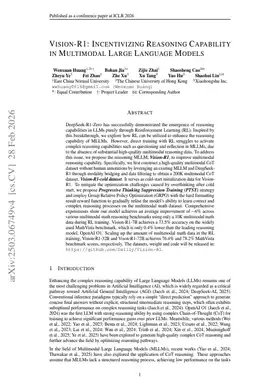
Vision-R1: Incentivizing Reasoning Capability in Multimodal Large Language Models
DeepSeek-R1-Zero has successfully demonstrated the emergence of reasoning capabilities in LLMs purely through Reinforcement Learning (RL). Inspired by this breakthrough, we explore how RL can be utilized to enhance the reasoning capability of MLLMs. However, direct training with RL struggles to activate complex reasoning capabilities such as questioning and reflection in MLLMs, due to the absence
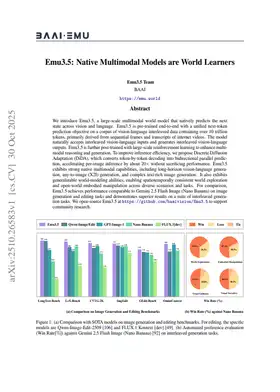
Emu3.5: Native Multimodal Models are World Learners
We introduce Emu3.5, a large-scale multimodal world model that natively predicts the next state across vision and language. Emu3.5 is pre-trained end-to-end with a unified next-token prediction objective on a corpus of vision-language interleaved data containing over 10 trillion tokens, primarily derived from sequential frames and transcripts of internet videos. The model naturally accepts interle
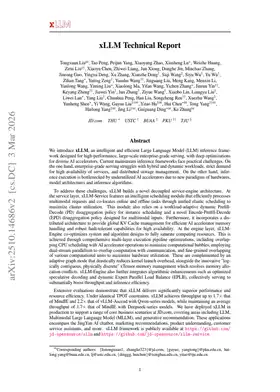
xLLM Technical Report
We introduce xLLM, an intelligent and efficient Large Language Model (LLM) inference framework designed for high-performance, large-scale enterprise-grade serving, with deep optimizations for diverse AI accelerators. To address these challenges, xLLM builds a novel decoupled service-engine architecture. At the service layer, xLLM-Service features an intelligent scheduling module that efficiently p
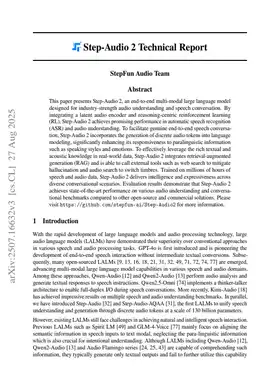
Step-Audio 2 Technical Report
This paper presents Step-Audio 2, an end-to-end multi-modal large language model designed for industry-strength audio understanding and speech conversation. By integrating a latent audio encoder and reasoning-centric reinforcement learning (RL), Step-Audio 2 achieves promising performance in automatic speech recognition (ASR) and audio understanding. To facilitate genuine end-to-end speech convers
End-to-end Listen, Look, Speak and Act
Human interaction is inherently multimodal and full-duplex: we listen while watching, speak while acting, and fluidly adapt to turn-taking and interruptions. Realizing these capabilities is essential for building models simulating humans. We present ELLSA (End-to-end Listen, Look, Speak and Act), which, to our knowledge, is the first full-duplex, end-to-end model that simultaneously perceives and
Reinforcement Fine-Tuning Powers Reasoning Capability of Multimodal Large Language Models
Standing in 2025, at a critical juncture in the pursuit of Artificial General Intelligence (AGI), reinforcement fine-tuning (RFT) has demonstrated significant potential in enhancing the reasoning capability of large language models (LLMs) and has led to the development of cutting-edge AI models such as OpenAI-o1 and DeepSeek-R1. Moreover, the efficient application of RFT to enhance the reasoning c
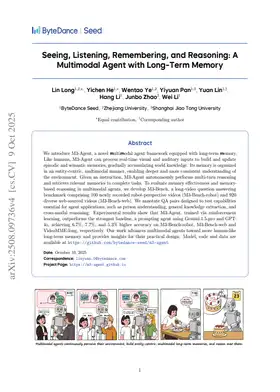
Seeing, Listening, Remembering, and Reasoning: A Multimodal Agent with Long-Term Memory
We introduce M3-Agent, a novel multimodal agent framework equipped with long-term memory. Like humans, M3-Agent can process real-time visual and auditory inputs to build and update episodic and semantic memories, gradually accumulating world knowledge. Its memory is organized in an entity-centric, multimodal manner, enabling deeper and more consistent understanding of the environment. Given an ins
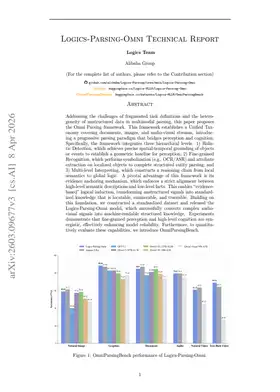
Logics-Parsing-Omni Technical Report
Addressing the challenges of fragmented task definitions and the heterogeneity of unstructured data in multimodal parsing, this paper proposes the Omni Parsing framework. This framework establishes a Unified Taxonomy covering documents, images, and audio-visual streams, introducing a progressive parsing paradigm that bridges perception and cognition. Specifically, the framework integrates three hi
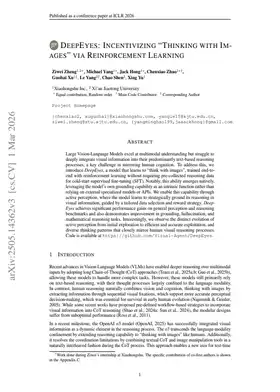
DeepEyes: Incentivizing "Thinking with Images" via Reinforcement Learning
Large Vision-Language Models excel at multimodal understanding but struggle to deeply integrate visual information into their predominantly text-based reasoning processes, a key challenge in mirroring human cognition. To address this, we introduce DeepEyes, a model that learns to "think with images", trained end-to-end with reinforcement learning without requiring pre-collected reasoning data for
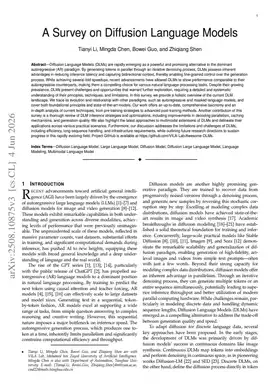
A Survey on Diffusion Language Models
Diffusion Language Models (DLMs) are rapidly emerging as a powerful and promising alternative to the dominant autoregressive (AR) paradigm. By generating tokens in parallel through an iterative denoising process, DLMs possess inherent advantages in reducing inference latency and capturing bidirectional context, thereby enabling fine-grained control over the generation process. While achieving a se
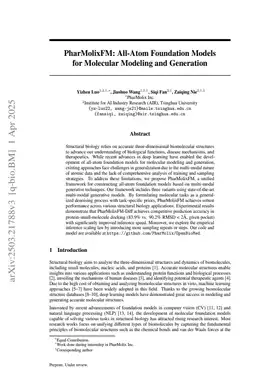
PharMolixFM: All-Atom Foundation Models for Molecular Modeling and Generation
Structural biology relies on accurate three-dimensional biomolecular structures to advance our understanding of biological functions, disease mechanisms, and therapeutics. While recent advances in deep learning have enabled the development of all-atom foundation models for molecular modeling and generation, existing approaches face challenges in generalization due to the multi-modal nature of atom
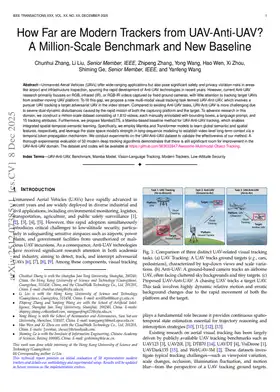
How Far are Modern Trackers from UAV-Anti-UAV? A Million-Scale Benchmark and New Baseline
Unmanned Aerial Vehicles (UAVs) offer wide-ranging applications but also pose significant safety and privacy violation risks in areas like airport and infrastructure inspection, spurring the rapid development of Anti-UAV technologies in recent years. However, current Anti-UAV research primarily focuses on RGB, infrared (IR), or RGB-IR videos captured by fixed ground cameras, with little attention
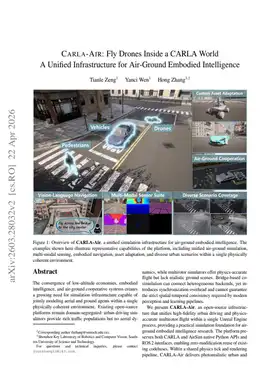
CARLA-Air: Fly Drones Inside a CARLA World -- A Unified Infrastructure for Air-Ground Embodied Intelligence
The convergence of low-altitude economies, embodied intelligence, and air-ground cooperative systems creates growing demand for simulation infrastructure capable of jointly modeling aerial and ground agents within a single physically coherent environment. Existing open-source platforms remain domain-segregated: driving simulators lack aerial dynamics, while multirotor simulators lack realistic gro