
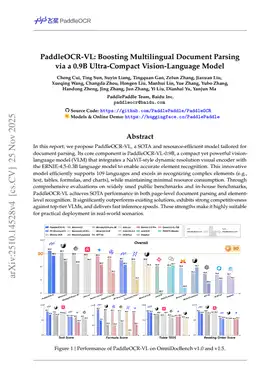
PaddleOCR-VL: Boosting Multilingual Document Parsing via a 0.9B Ultra-Compact Vision-Language Model
In this report, we propose PaddleOCR-VL, a SOTA and resource-efficient model tailored for document parsing. Its core component is PaddleOCR-VL-0.9B, a compact yet powerful vision-language model (VLM) that integrates a NaViT-style dynamic resolution visual encoder with the ERNIE-4.5-0.3B language model to enable accurate element recognition. This innovative model efficiently supports 109 languages
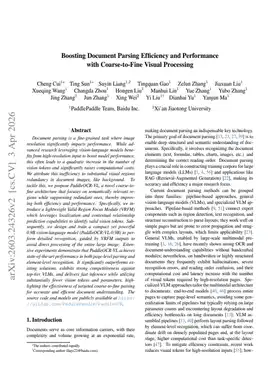
Boosting Document Parsing Efficiency and Performance with Coarse-to-Fine Visual Processing
Document parsing is a fine-grained task where image resolution significantly impacts performance. While advanced research leveraging vision-language models benefits from high-resolution input to boost model performance, this often leads to a quadratic increase in the number of vision tokens and significantly raises computational costs. We attribute this inefficiency to substantial visual regions r

PP-OCRv5: A Specialized 5M-Parameter Model Rivaling Billion-Parameter Vision-Language Models on OCR Tasks
The advent of "OCR 2.0" and large-scale vision-language models (VLMs) has set new benchmarks in text recognition. However, these unified architectures often come with significant computational demands, challenges in precise text localization within complex layouts, and a propensity for textual hallucinations. Revisiting the prevailing notion that model scale is the sole path to high accuracy, this
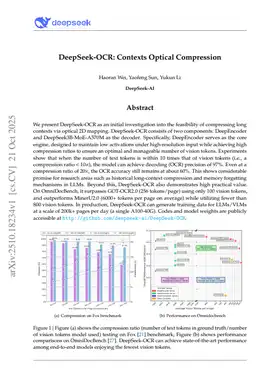
DeepSeek-OCR: Contexts Optical Compression
We present DeepSeek-OCR as an initial investigation into the feasibility of compressing long contexts via optical 2D mapping. DeepSeek-OCR consists of two components: DeepEncoder and DeepSeek3B-MoE-A570M as the decoder. Specifically, DeepEncoder serves as the core engine, designed to maintain low activations under high-resolution input while achieving high compression ratios to ensure an optimal a
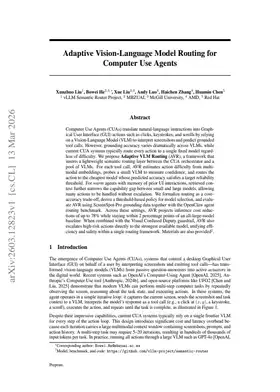
Adaptive Vision-Language Model Routing for Computer Use Agents
Computer Use Agents (CUAs) translate natural-language instructions into Graphical User Interface (GUI) actions such as clicks, keystrokes, and scrolls by relying on a Vision-Language Model (VLM) to interpret screenshots and predict grounded tool calls. However, grounding accuracy varies dramatically across VLMs, while current CUA systems typically route every action to a single fixed model regardl
Paper2Poster: Towards Multimodal Poster Automation from Scientific Papers
Academic poster generation is a crucial yet challenging task in scientific communication, requiring the compression of long-context interleaved documents into a single, visually coherent page. To address this challenge, we introduce the first benchmark and metric suite for poster generation, which pairs recent conference papers with author-designed posters and evaluates outputs on (i)Visual Qualit
DeepSeek-OCR 2: Visual Causal Flow
We present DeepSeek-OCR 2 to investigate the feasibility of a novel encoder-DeepEncoder V2-capable of dynamically reordering visual tokens upon image semantics. Conventional vision-language models (VLMs) invariably process visual tokens in a rigid raster-scan order (top-left to bottom-right) with fixed positional encoding when fed into LLMs. However, this contradicts human visual perception, which
GLM-4.5V and GLM-4.1V-Thinking: Towards Versatile Multimodal Reasoning with Scalable Reinforcement Learning
We present GLM-4.1V-Thinking, GLM-4.5V, and GLM-4.6V, a family of vision-language models (VLMs) designed to advance general-purpose multimodal understanding and reasoning. In this report, we share our key findings in the development of the reasoning-centric training framework. We first develop a capable vision foundation model with significant potential through large-scale pre-training, which argu
Alpamayo-R1: Bridging Reasoning and Action Prediction for Generalizable Autonomous Driving in the Long Tail
End-to-end architectures trained via imitation learning have advanced autonomous driving by scaling model size and data, yet performance remains brittle in safety-critical long-tail scenarios where supervision is sparse and causal understanding is limited. We introduce Alpamayo-R1 (AR1), a vision-language-action model (VLA) that integrates Chain of Causation reasoning with trajectory planning for
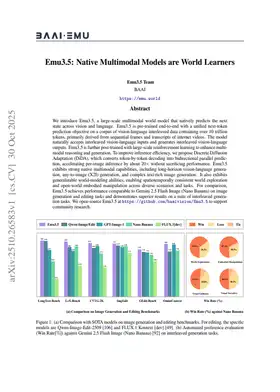
Emu3.5: Native Multimodal Models are World Learners
We introduce Emu3.5, a large-scale multimodal world model that natively predicts the next state across vision and language. Emu3.5 is pre-trained end-to-end with a unified next-token prediction objective on a corpus of vision-language interleaved data containing over 10 trillion tokens, primarily derived from sequential frames and transcripts of internet videos. The model naturally accepts interle
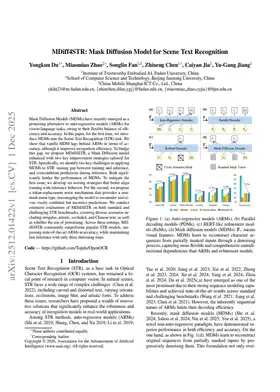
MDiff4STR: Mask Diffusion Model for Scene Text Recognition
Mask Diffusion Models (MDMs) have recently emerged as a promising alternative to auto-regressive models (ARMs) for vision-language tasks, owing to their flexible balance of efficiency and accuracy. In this paper, for the first time, we introduce MDMs into the Scene Text Recognition (STR) task. We show that vanilla MDM lags behind ARMs in terms of accuracy, although it improves recognition efficien
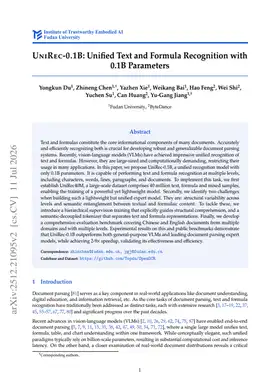
UniRec-0.1B: Unified Text and Formula Recognition with 0.1B Parameters
Text and formulas constitute the core informational components of many documents. Accurately and efficiently recognizing both is crucial for developing robust and generalizable document parsing systems. Recently, vision-language models (VLMs) have achieved impressive unified recognition of text and formulas. However, they are large-sized and computationally demanding, restricting their usage in ma
World Simulation with Video Foundation Models for Physical AI
We introduce [Cosmos-Predict2.5], the latest generation of the Cosmos World Foundation Models for Physical AI. Built on a flow-based architecture, [Cosmos-Predict2.5] unifies Text2World, Image2World, and Video2World generation in a single model and leverages [Cosmos-Reason1], a Physical AI vision-language model, to provide richer text grounding and finer control of world simulation. Trained on 200
DeepEyes: Incentivizing "Thinking with Images" via Reinforcement Learning
Large Vision-Language Models excel at multimodal understanding but struggle to deeply integrate visual information into their predominantly text-based reasoning processes, a key challenge in mirroring human cognition. To address this, we introduce DeepEyes, a model that learns to "think with images", trained end-to-end with reinforcement learning without requiring pre-collected reasoning data for
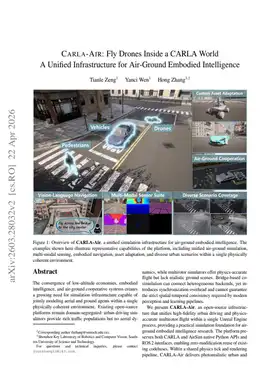
CARLA-Air: Fly Drones Inside a CARLA World -- A Unified Infrastructure for Air-Ground Embodied Intelligence
The convergence of low-altitude economies, embodied intelligence, and air-ground cooperative systems creates growing demand for simulation infrastructure capable of jointly modeling aerial and ground agents within a single physically coherent environment. Existing open-source platforms remain domain-segregated: driving simulators lack aerial dynamics, while multirotor simulators lack realistic gro
StreamingVLM: Real-Time Understanding for Infinite Video Streams
Vision-language models (VLMs) could power real-time assistants and autonomous agents, but they face a critical challenge: understanding near-infinite video streams without escalating latency and memory usage. Processing entire videos with full attention leads to quadratic computational costs and poor performance on long videos. Meanwhile, simple sliding window methods are also flawed, as they eith
Hulu-Med: A Transparent Generalist Model towards Holistic Medical Vision-Language Understanding
Real-world clinical decision-making requires integrating heterogeneous data, including medical text, 2D images, 3D volumes, and videos, while existing AI systems fail to unify all these signals, limiting their utility. In this paper, we introduce Hulu-Med, a transparent, generalist medical Vision-Language Model (VLM) designed to unify language-only, 2D/3D vision-language, and video understanding w
VRAG-RL: Empower Vision-Perception-Based RAG for Visually Rich Information Understanding via Iterative Reasoning with Reinforcement Learning
Effectively retrieving, reasoning and understanding visually rich information remains a challenge for RAG methods. Traditional text-based methods cannot handle visual-related information. On the other hand, current vision-based RAG approaches are often limited by fixed pipelines and frequently struggle to reason effectively due to the insufficient activation of the fundamental capabilities of mode
From Pixels to Words -- Towards Native Vision-Language Primitives at Scale
The edifice of native Vision-Language Models (VLMs) has emerged as a rising contender to typical modular VLMs, shaped by evolving model architectures and training paradigms. Yet, two lingering clouds cast shadows over its widespread exploration and promotion: (-) What fundamental constraints set native VLMs apart from modular ones, and to what extent can these barriers be overcome? (-) How to make
From Pixels to Words -- Towards Native One-Vision Models at Scale
Current vision-language models (VLMs) typically stitch together separate image encoders and language decoders via multi-stage alignment, a modular framework that inevitably fragments pixel-level signals across frames and scatters early pixel-word interactions. In parallel, native VLMs, despite impressive performance on single images, remain largely unexplored in multi-image, video understanding, a
Modular Embedding Recomposition for Incremental Learning
The advent of pre-trained Vision-Language Models (VLMs) has significantly transformed Continual Learning (CL), mainly due to their zero-shot classification abilities. Such proficiency makes VLMs well-suited for real-world applications, enabling robust performance on novel unseen classes without requiring adaptation. However, fine-tuning remains essential when downstream tasks deviate significantly
FutureSightDrive: Thinking Visually with Spatio-Temporal CoT for Autonomous Driving
Vision-Language-Action (VLA) models offer significant potential for end-to-end driving, yet their reasoning is often constrained by textual Chains-of-Thought (CoT). This symbolic compression of visual information creates a modality gap between perception and planning by blurring spatio-temporal relations and discarding fine-grained cues. We introduce FSDrive, a framework that empowers VLAs to "thi
LLMC+: Benchmarking Vision-Language Model Compression with a Plug-and-play Toolkit
Large Vision-Language Models (VLMs) exhibit impressive multi-modal capabilities but suffer from prohibitive computational and memory demands, due to their long visual token sequences and massive parameter sizes. To address these issues, recent works have proposed training-free compression methods. However, existing efforts often suffer from three major limitations: (1) Current approaches do not de
Glyph: Scaling Context Windows via Visual-Text Compression
Large language models (LLMs) increasingly rely on long-context modeling for tasks such as document understanding, code analysis, and multi-step reasoning. However, scaling context windows to the million-token level brings prohibitive computational and memory costs, limiting the practicality of long-context LLMs. In this work, we take a different perspective-visual context scaling-to tackle this ch
DeepThinkVLA: Enhancing Reasoning Capability of Vision-Language-Action Models
Does Chain-of-Thought (CoT) reasoning genuinely improve Vision-Language-Action (VLA) models, or does it merely add overhead? Existing CoT-VLA systems report limited and inconsistent gains, yet no prior work has rigorously diagnosed when and why CoT helps robots act. Through systematic experiments, we identify two necessary conditions that must be jointly satisfied for CoT to be effective in VLA: (