
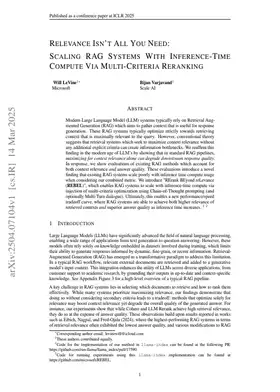
Relevance Isn't All You Need: Scaling RAG Systems With Inference-Time Compute Via Multi-Criteria Reranking
Modern Large Language Model (LLM) systems typically rely on Retrieval Augmented Generation (RAG) which aims to gather context that is useful for response generation. These RAG systems typically optimize strictly towards retrieving context that is maximally relevant to the query. However, conventional theory suggests that retrieval systems which seek to maximize context relevance without any additi
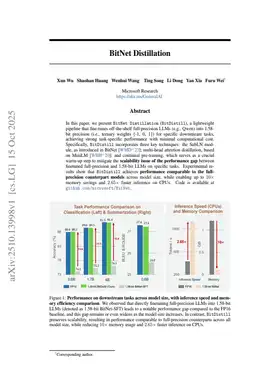
BitNet Distillation
In this paper, we present BitNet Distillation (BitDistill), a lightweight pipeline that fine-tunes off-the-shelf full-precision LLMs (e.g., Qwen) into 1.58-bit precision (i.e., ternary weights {-1, 0, 1}) for specific downstream tasks, achieving strong task-specific performance with minimal computational cost. Specifically, BitDistill incorporates three key techniques: the SubLN module, as introdu

Kronos: A Foundation Model for the Language of Financial Markets
The success of large-scale pre-training paradigm, exemplified by Large Language Models (LLMs), has inspired the development of Time Series Foundation Models (TSFMs). However, their application to financial candlestick (K-line) data remains limited, often underperforming non-pre-trained architectures. Moreover, existing TSFMs often overlook crucial downstream tasks such as volatility prediction and

Multi-Agent Collaboration via Evolving Orchestration
Large language models (LLMs) have achieved remarkable results across diverse downstream tasks, but their monolithic nature restricts scalability and efficiency in complex problem-solving. While recent research explores multi-agent collaboration among LLMs, most approaches rely on static organizational structures that struggle to adapt as task complexity and agent numbers grow, resulting in coordin
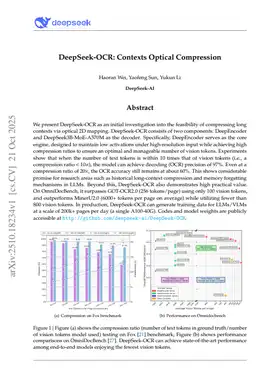
DeepSeek-OCR: Contexts Optical Compression
We present DeepSeek-OCR as an initial investigation into the feasibility of compressing long contexts via optical 2D mapping. DeepSeek-OCR consists of two components: DeepEncoder and DeepSeek3B-MoE-A570M as the decoder. Specifically, DeepEncoder serves as the core engine, designed to maintain low activations under high-resolution input while achieving high compression ratios to ensure an optimal a
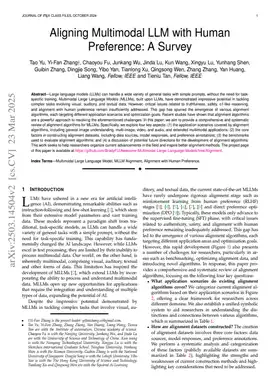
Aligning Multimodal LLM with Human Preference: A Survey
Large language models (LLMs) can handle a wide variety of general tasks with simple prompts, without the need for task-specific training. Multimodal Large Language Models (MLLMs), built upon LLMs, have demonstrated impressive potential in tackling complex tasks involving visual, auditory, and textual data. However, critical issues related to truthfulness, safety, o1-like reasoning, and alignment w

AI-native Memory 2.0: Second Me
Human interaction with the external world fundamentally involves the exchange of personal memory, whether with other individuals, websites, applications, or, in the future, AI agents. A significant portion of this interaction is redundant, requiring users to repeatedly provide the same information across different contexts. Existing solutions, such as browser-stored credentials, autofill mechanism
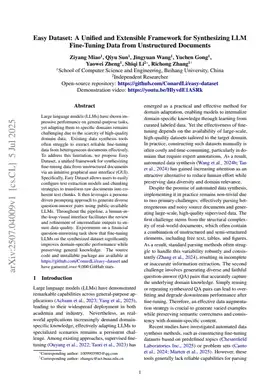
Easy Dataset: A Unified and Extensible Framework for Synthesizing LLM Fine-Tuning Data from Unstructured Documents
Large language models (LLMs) have shown impressive performance on general-purpose tasks, yet adapting them to specific domains remains challenging due to the scarcity of high-quality domain data. Existing data synthesis tools often struggle to extract reliable fine-tuning data from heterogeneous documents effectively. To address this limitation, we propose Easy Dataset, a unified framework for syn
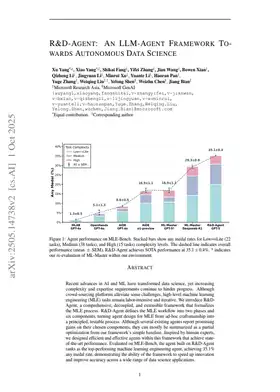
R&D-Agent: An LLM-Agent Framework Towards Autonomous Data Science
Recent advances in AI and ML have transformed data science, yet increasing complexity and expertise requirements continue to hinder progress. Although crowd-sourcing platforms alleviate some challenges, high-level machine learning engineering (MLE) tasks remain labor-intensive and iterative. We introduce R&D-Agent, a comprehensive, decoupled, and extensible framework that formalizes the MLE proces
Trae Agent: An LLM-based Agent for Software Engineering with Test-time Scaling
Software issue resolution is a critical challenge in software engineering and has garnered increasing attention in recent years. With the rapid advancement of large language models (LLMs), substantial progress has been made in addressing real-world software engineering tasks. Recent studies have introduced ensemble reasoning techniques to enhance the performance of LLM-based issue resolution. Howe
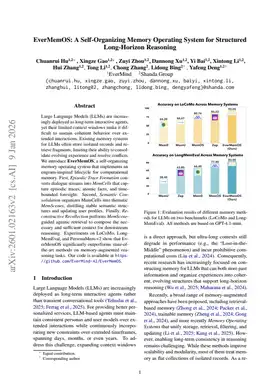
EverMemOS: A Self-Organizing Memory Operating System for Structured Long-Horizon Reasoning
Large Language Models (LLMs) are increasingly deployed as long-term interactive agents, yet their limited context windows make it difficult to sustain coherent behavior over extended interactions. Existing memory systems often store isolated records and retrieve fragments, limiting their ability to consolidate evolving user states and resolve conflicts. We introduce EverMemOS, a self-organizing me
Spark-TTS: An Efficient LLM-Based Text-to-Speech Model with Single-Stream Decoupled Speech Tokens
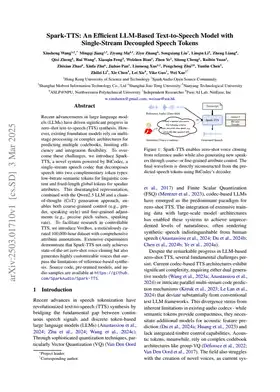
Recent advancements in large language models (LLMs) have driven significant progress in zero-shot text-to-speech (TTS) synthesis. However, existing foundation models rely on multi-stage processing or complex architectures for predicting multiple codebooks, limiting efficiency and integration flexibility. To overcome these challenges, we introduce Spark-TTS, a novel system powered by BiCodec, a sin
LMCache: An Efficient KV Cache Layer for Enterprise-Scale LLM Inference
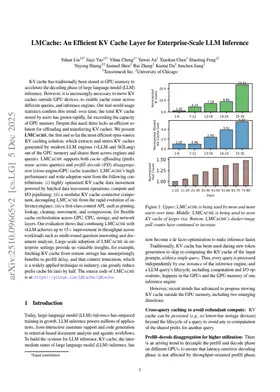
KV cache has traditionally been stored in GPU memory to accelerate the decoding phase of large language model (LLM) inference. However, it is increasingly necessary to move KV caches outside GPU devices, to enable cache reuse across different queries and inference engines. Our real-world usage statistics confirm this trend: over time, the total KV cache stored by users has grown rapidly, far excee
TinyTroupe: An LLM-powered Multiagent Persona Simulation Toolkit
Recent advances in Large Language Models (LLM) have led to a new class of autonomous agents, renewing and expanding interest in the area. LLM-powered Multiagent Systems (MAS) have thus emerged, both for assistive and simulation purposes, yet tools for realistic human behavior simulation -- with its distinctive challenges and opportunities -- remain underdeveloped. Existing MAS libraries and tools
GEPA: Reflective Prompt Evolution Can Outperform Reinforcement Learning
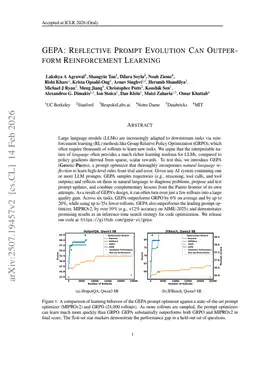
Large language models (LLMs) are increasingly adapted to downstream tasks via reinforcement learning (RL) methods like Group Relative Policy Optimization (GRPO), which often require thousands of rollouts to learn new tasks. We argue that the interpretable nature of language often provides a much richer learning medium for LLMs, compared to policy gradients derived from sparse, scalar rewards. To t
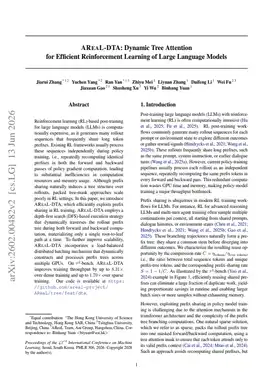
AREAL-DTA: Dynamic Tree Attention for Efficient Reinforcement Learning of Large Language Models
Reinforcement learning (RL)-based post-training for large language models (LLMs) is computationally expensive, as it generates many rollout sequences that frequently share long token prefixes. Existing RL frameworks usually process these sequences independently during policy training, i.e., repeatedly recomputing identical prefixes in both the forward and backward passes of policy gradient computa
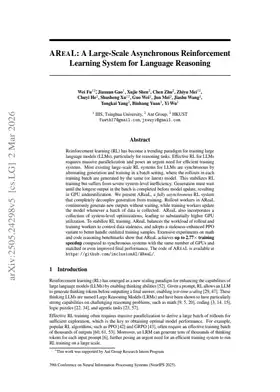
AReaL: A Large-Scale Asynchronous Reinforcement Learning System for Language Reasoning
Reinforcement learning (RL) has become a dominant paradigm for training large language models (LLMs), particularly for reasoning tasks. Effective RL for LLMs requires massive parallelization and poses an urgent need for efficient training systems. Most existing large-scale RL systems for LLMs are synchronous, alternating generation and training in a batch setting where rollouts in each training ba
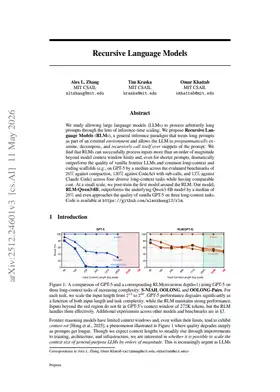
Recursive Language Models
We study allowing large language models (LLMs) to process arbitrarily long prompts through the lens of inference-time scaling. We propose Recursive Language Models (RLMs), a general inference paradigm that treats long prompts as part of an external environment and allows the LLM to programmatically examine, decompose, and recursively call itself over snippets of the prompt. We find that RLMs can s
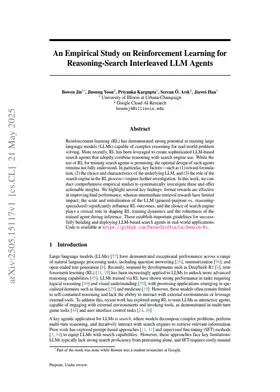
An Empirical Study on Reinforcement Learning for Reasoning-Search Interleaved LLM Agents
Reinforcement learning (RL) has demonstrated strong potential in training large language models (LLMs) capable of complex reasoning for real-world problem solving. More recently, RL has been leveraged to create sophisticated LLM-based search agents that adeptly combine reasoning with search engine use. While the use of RL for training search agents is promising, the optimal design of such agents r
Search-R1: Training LLMs to Reason and Leverage Search Engines with Reinforcement Learning
Efficiently acquiring external knowledge and up-to-date information is essential for effective reasoning and text generation in large language models (LLMs). Prompting advanced LLMs with reasoning capabilities to use search engines during inference is often suboptimal, as the LLM might not fully possess the capability on how to interact optimally with the search engine. This paper introduces Searc
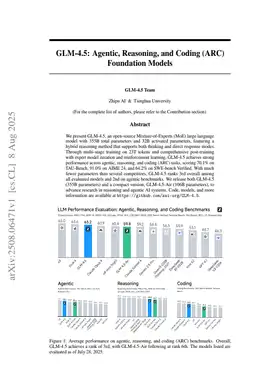
GLM-4.5: Agentic, Reasoning, and Coding (ARC) Foundation Models
We present GLM-4.5, an open-source Mixture-of-Experts (MoE) large language model with 355B total parameters and 32B activated parameters, featuring a hybrid reasoning method that supports both thinking and direct response modes. Through multi-stage training on 23T tokens and comprehensive post-training with expert model iteration and reinforcement learning, GLM-4.5 achieves strong performance acro
EvolveMem:Self-Evolving Memory Architecture via AutoResearch for LLM Agents
Long-term memory is essential for LLM agents that operate across multiple sessions, yet existing memory systems treat retrieval infrastructure as fixed: stored content evolves while scoring functions, fusion strategies, and answer-generation policies remain frozen at deployment. We argue that truly adaptive memory requires co-evolution at two levels: the stored knowledge and the retrieval mechanis
SimpleMem: Efficient Lifelong Memory for LLM Agents
To support long-term interaction in complex environments, LLM agents require memory systems that manage historical experiences. Existing approaches either retain full interaction histories via passive context extension, leading to substantial redundancy, or rely on iterative reasoning to filter noise, incurring high token costs. To address this challenge, we introduce SimpleMem, an efficient memor
FinRL-X: An AI-Native Modular Infrastructure for Quantitative Trading
We present FinRL-X, a modular and deployment-consistent trading architecture that unifies data processing, strategy construction, backtesting, and broker execution under a weight-centric interface. While existing open-source platforms are often backtesting- or model-centric, they rarely provide system-level consistency between research evaluation and live deployment. FinRL-X addresses this gap thr
MetaClaw: Just Talk -- An Agent That Meta-Learns and Evolves in the Wild
Large language model (LLM) agents are increasingly used for complex tasks, yet deployed agents often remain static, failing to adapt as user needs evolve. This creates a tension between the need for continuous service and the necessity of updating capabilities to match shifting task distributions. On platforms like OpenClaw, which handle diverse workloads across 20+ channels, existing methods eith