
MimicKit: A Reinforcement Learning Framework for Motion Imitation and Control
MimicKit is an open-source framework for training motion controllers using motion imitation and reinforcement learning. The codebase provides implementations of commonly-used motion-imitation techniques and RL algorithms. This framework is intended to support research and applications in computer graphics and robotics by providing a unified training framework, along with standardized environment,
End-to-end Listen, Look, Speak and Act
Human interaction is inherently multimodal and full-duplex: we listen while watching, speak while acting, and fluidly adapt to turn-taking and interruptions. Realizing these capabilities is essential for building models simulating humans. We present ELLSA (End-to-end Listen, Look, Speak and Act), which, to our knowledge, is the first full-duplex, end-to-end model that simultaneously perceives and
Seeing, Listening, Remembering, and Reasoning: A Multimodal Agent with Long-Term Memory
We introduce M3-Agent, a novel multimodal agent framework equipped with long-term memory. Like humans, M3-Agent can process real-time visual and auditory inputs to build and update episodic and semantic memories, gradually accumulating world knowledge. Its memory is organized in an entity-centric, multimodal manner, enabling deeper and more consistent understanding of the environment. Given an ins
3D Scene Generation: A Survey
3D scene generation seeks to synthesize spatially structured, semantically meaningful, and photorealistic environments for applications such as immersive media, robotics, autonomous driving, and embodied AI. Early methods based on procedural rules offered scalability but limited diversity. Recent advances in deep generative models (e.g., GANs, diffusion models) and 3D representations (e.g., NeRF,
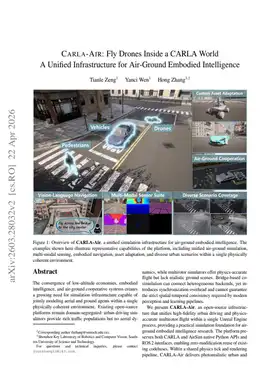
CARLA-Air: Fly Drones Inside a CARLA World -- A Unified Infrastructure for Air-Ground Embodied Intelligence
The convergence of low-altitude economies, embodied intelligence, and air-ground cooperative systems creates growing demand for simulation infrastructure capable of jointly modeling aerial and ground agents within a single physically coherent environment. Existing open-source platforms remain domain-segregated: driving simulators lack aerial dynamics, while multirotor simulators lack realistic gro
Cosmos-Transfer1: Conditional World Generation with Adaptive Multimodal Control
We introduce Cosmos-Transfer, a conditional world generation model that can generate world simulations based on multiple spatial control inputs of various modalities such as segmentation, depth, and edge. In the design, the spatial conditional scheme is adaptive and customizable. It allows weighting different conditional inputs differently at different spatial locations. This enables highly contro
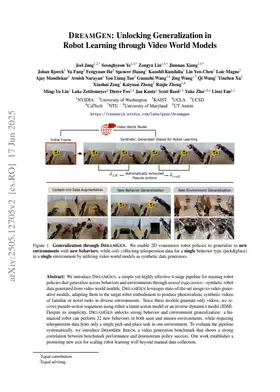
DreamGen: Unlocking Generalization in Robot Learning through Video World Models
We introduce DreamGen, a simple yet highly effective 4-stage pipeline for training robot policies that generalize across behaviors and environments through neural trajectories - synthetic robot data generated from video world models. DreamGen leverages state-of-the-art image-to-video generative models, adapting them to the target robot embodiment to produce photorealistic synthetic videos of famil
DeepThinkVLA: Enhancing Reasoning Capability of Vision-Language-Action Models
Does Chain-of-Thought (CoT) reasoning genuinely improve Vision-Language-Action (VLA) models, or does it merely add overhead? Existing CoT-VLA systems report limited and inconsistent gains, yet no prior work has rigorously diagnosed when and why CoT helps robots act. Through systematic experiments, we identify two necessary conditions that must be jointly satisfied for CoT to be effective in VLA: (
GS-SDF: LiDAR-Augmented Gaussian Splatting and Neural SDF for Geometrically Consistent Rendering and Reconstruction
Digital twins are fundamental to the development of autonomous driving and embodied artificial intelligence. However, achieving high-granularity surface reconstruction and high-fidelity rendering remains a challenge. Gaussian splatting offers efficient photorealistic rendering but struggles with geometric inconsistencies due to fragmented primitives and sparse observational data in robotics applic
HumanEgo: Zero-Shot Robot Learning from Minutes of Human Egocentric Videos
Human egocentric video captures rich manipulation demonstrations without any robot hardware, yet transferring these skills to robots remains challenging due to the embodiment gap between human and robot in both visual appearance and kinematics. We present HumanEgo, a framework that bridges the embodiment gap by lifting each human demonstration to an entity-level representation of hand-object inter
What Drives Success in Physical Planning with Joint-Embedding Predictive World Models?
A long-standing challenge in AI is to develop agents capable of solving a wide range of physical tasks and generalizing to new, unseen tasks and environments. A popular recent approach involves training a world model from state-action trajectories and subsequently use it with a planning algorithm to solve new tasks. Planning is commonly performed in the input space, but a recent family of methods
Large VLM-based Vision-Language-Action Models for Robotic Manipulation: A Survey
Robotic manipulation, a key frontier in robotics and embodied AI, requires precise motor control and multimodal understanding, yet traditional rule-based methods fail to scale or generalize in unstructured, novel environments. In recent years, Vision-Language-Action (VLA) models, built upon Large Vision-Language Models (VLMs) pretrained on vast image-text datasets, have emerged as a transformative
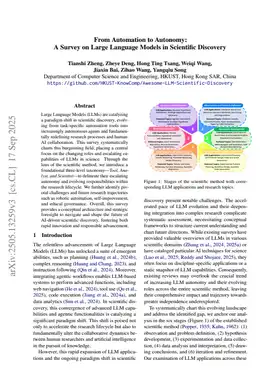
From Automation to Autonomy: A Survey on Large Language Models in Scientific Discovery
Large Language Models (LLMs) are catalyzing a paradigm shift in scientific discovery, evolving from task-specific automation tools into increasingly autonomous agents and fundamentally redefining research processes and human-AI collaboration. This survey systematically charts this burgeoning field, placing a central focus on the changing roles and escalating capabilities of LLMs in science. Throug
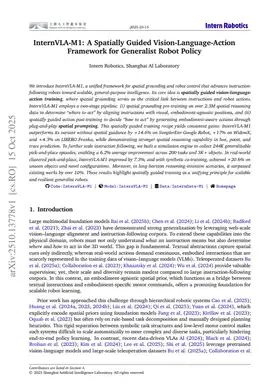
InternVLA-M1: A Spatially Guided Vision-Language-Action Framework for Generalist Robot Policy
We introduce InternVLA-M1, a unified framework for spatial grounding and robot control that advances instruction-following robots toward scalable, general-purpose intelligence. Its core idea is spatially guided vision-language-action training, where spatial grounding serves as the critical link between instructions and robot actions. InternVLA-M1 employs a two-stage pipeline: (i) spatial grounding
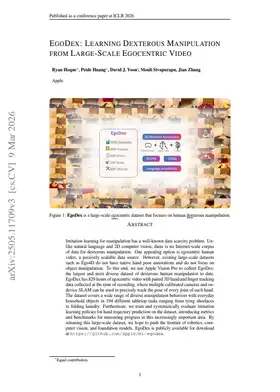
EgoDex: Learning Dexterous Manipulation from Large-Scale Egocentric Video
Imitation learning for manipulation has a well-known data scarcity problem. Unlike natural language and 2D computer vision, there is no Internet-scale corpus of data for dexterous manipulation. One appealing option is egocentric human video, a passively scalable data source. However, existing large-scale datasets such as Ego4D do not have native hand pose annotations and do not focus on object man
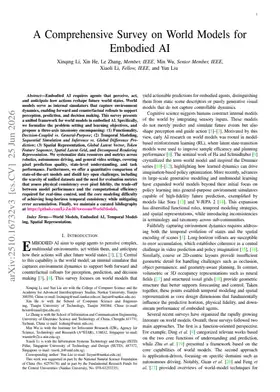
A Comprehensive Survey on World Models for Embodied AI
Embodied AI requires agents that perceive, act, and anticipate how actions reshape future world states. World models serve as internal simulators that capture environment dynamics, enabling forward and counterfactual rollouts to support perception, prediction, and decision making. This survey presents a unified framework for world models in embodied AI. Specifically, we formalize the problem setti
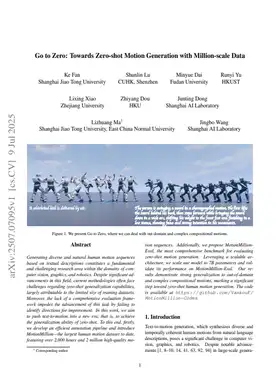
Go to Zero: Towards Zero-shot Motion Generation with Million-scale Data
Generating diverse and natural human motion sequences based on textual descriptions constitutes a fundamental and challenging research area within the domains of computer vision, graphics, and robotics. Despite significant advancements in this field, current methodologies often face challenges regarding zero-shot generalization capabilities, largely attributable to the limited size of training dat
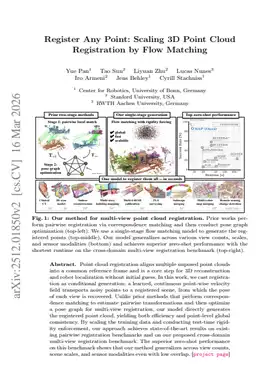
Register Any Point: Scaling 3D Point Cloud Registration by Flow Matching
Point cloud registration aligns multiple unposed point clouds into a common reference frame and is a core step for 3D reconstruction and robot localization without initial guess. In this work, we cast registration as conditional generation: a learned, continuous point-wise velocity field transports noisy points to a registered scene, from which the pose of each view is recovered. Unlike prior meth
CuSfM: CUDA-Accelerated Structure-from-Motion
Efficient and accurate camera pose estimation forms the foundational requirement for dense reconstruction in autonomous navigation, robotic perception, and virtual simulation systems. This paper addresses the challenge via cuSfM, a CUDA-accelerated offline Structure-from-Motion system that leverages GPU parallelization to efficiently employ computationally intensive yet highly accurate feature ext
Towards Generalizable Robotic Manipulation in Dynamic Environments
Vision-Language-Action (VLA) models excel in static manipulation but struggle in dynamic environments with moving targets. This performance gap primarily stems from a scarcity of dynamic manipulation datasets and the reliance of mainstream VLAs on single-frame observations, restricting their spatiotemporal reasoning capabilities. To address this, we introduce DOMINO, a large-scale dataset and benc
Towards Interactive Video World Modeling: Frontiers, Challenges, Benchmarks, and Future Trends
With rapid development of large language models and diffusion-based content generation, world modeling has attracted increasing research attention, benefiting various downstream domains such as game engines, embodied AI, autonomous driving, etc. Through explicitly incorporating user actions into world state transition, recent literature empowers world modeling with interactivity in an action-condi
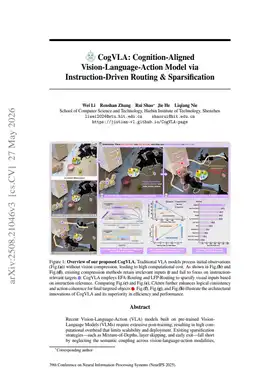
CogVLA: Cognition-Aligned Vision-Language-Action Model via Instruction-Driven Routing & Sparsification
Recent Vision-Language-Action (VLA) models built on pre-trained Vision-Language Models (VLMs) require extensive post-training, resulting in high computational overhead that limits scalability and deployment.We propose CogVLA, a Cognition-Aligned Vision-Language-Action framework that leverages instruction-driven routing and sparsification to improve both efficiency and performance. CogVLA draws ins
GeoFlow-SLAM: A Robust Tightly-Coupled RGBD-Inertial and Legged Odometry Fusion SLAM for Dynamic Legged Robotics
This paper presents GeoFlow-SLAM, a robust and effective Tightly-Coupled RGBD-inertial SLAM for legged robotics undergoing aggressive and high-frequency motions.By integrating geometric consistency, legged odometry constraints, and dual-stream optical flow (GeoFlow), our method addresses three critical challenges:feature matching and pose initialization failures during fast locomotion and visual f
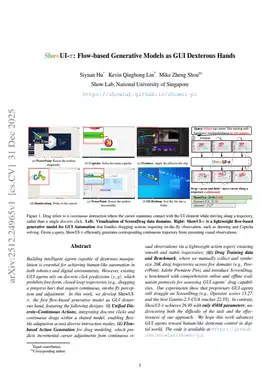
ShowUI-$π$: Flow-based Generative Models as GUI Dexterous Hands
Building intelligent agents capable of dexterous manipulation is essential for achieving human-like automation in both robotics and digital environments. However, existing GUI agents rely on discrete click predictions (x,y), which prohibits free-form, closed-loop trajectories (e.g. dragging a progress bar) that require continuous, on-the-fly perception and adjustment. In this work, we develop Show
Omnidirectional Multi-Object Tracking
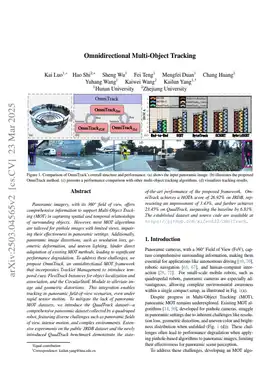
Panoramic imagery, with its 360° field of view, offers comprehensive information to support Multi-Object Tracking (MOT) in capturing spatial and temporal relationships of surrounding objects. However, most MOT algorithms are tailored for pinhole images with limited views, impairing their effectiveness in panoramic settings. Additionally, panoramic image distortions, such as resolution loss, geomet