Relevance Isn't All You Need: Scaling RAG Systems With Inference-Time Compute Via Multi-Criteria Reranking
Modern Large Language Model (LLM) systems typically rely on Retrieval Augmented Generation (RAG) which aims to gather context that is useful for response generation. These RAG systems typically optimize strictly towards retrieving context that is maximally relevant to the query. However, conventional theory suggests that retrieval systems which seek to maximize context relevance without any additi

Multi-Agent Collaboration via Evolving Orchestration
Large language models (LLMs) have achieved remarkable results across diverse downstream tasks, but their monolithic nature restricts scalability and efficiency in complex problem-solving. While recent research explores multi-agent collaboration among LLMs, most approaches rely on static organizational structures that struggle to adapt as task complexity and agent numbers grow, resulting in coordin
RAG-Anything: All-in-One RAG Framework
Retrieval-Augmented Generation (RAG) has emerged as a fundamental paradigm for expanding Large Language Models beyond their static training limitations. However, a critical misalignment exists between current RAG capabilities and real-world information environments. Modern knowledge repositories are inherently multimodal, containing rich combinations of textual content, visual elements, structured
WebDancer: Towards Autonomous Information Seeking Agency
Addressing intricate real-world problems necessitates in-depth information seeking and multi-step reasoning. Recent progress in agentic systems, exemplified by Deep Research, underscores the potential for autonomous multi-step research. In this work, we present a cohesive paradigm for building end-to-end agentic information seeking agents from a data-centric and training-stage perspective. Our app
Aligning Multimodal LLM with Human Preference: A Survey
Large language models (LLMs) can handle a wide variety of general tasks with simple prompts, without the need for task-specific training. Multimodal Large Language Models (MLLMs), built upon LLMs, have demonstrated impressive potential in tackling complex tasks involving visual, auditory, and textual data. However, critical issues related to truthfulness, safety, o1-like reasoning, and alignment w

AI-native Memory 2.0: Second Me
Human interaction with the external world fundamentally involves the exchange of personal memory, whether with other individuals, websites, applications, or, in the future, AI agents. A significant portion of this interaction is redundant, requiring users to repeatedly provide the same information across different contexts. Existing solutions, such as browser-stored credentials, autofill mechanism
AutoResearchClaw: Self-Reinforcing Autonomous Research with Human-AI Collaboration
Automating scientific discovery requires more than generating papers from ideas. Real research is iterative: hypotheses are challenged from multiple perspectives, experiments fail and inform the next attempt, and lessons accumulate across cycles. Existing autonomous research systems often model this process as a linear pipeline: they rely on single-agent reasoning, stop when execution fails, and d
Trae Agent: An LLM-based Agent for Software Engineering with Test-time Scaling
Software issue resolution is a critical challenge in software engineering and has garnered increasing attention in recent years. With the rapid advancement of large language models (LLMs), substantial progress has been made in addressing real-world software engineering tasks. Recent studies have introduced ensemble reasoning techniques to enhance the performance of LLM-based issue resolution. Howe
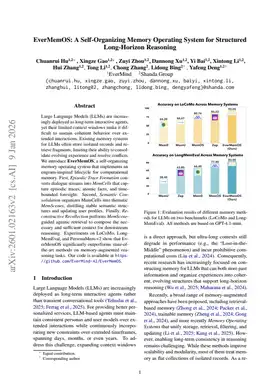
EverMemOS: A Self-Organizing Memory Operating System for Structured Long-Horizon Reasoning
Large Language Models (LLMs) are increasingly deployed as long-term interactive agents, yet their limited context windows make it difficult to sustain coherent behavior over extended interactions. Existing memory systems often store isolated records and retrieve fragments, limiting their ability to consolidate evolving user states and resolve conflicts. We introduce EverMemOS, a self-organizing me
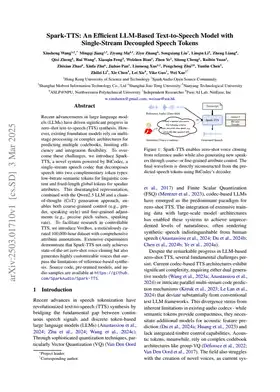
Spark-TTS: An Efficient LLM-Based Text-to-Speech Model with Single-Stream Decoupled Speech Tokens
Recent advancements in large language models (LLMs) have driven significant progress in zero-shot text-to-speech (TTS) synthesis. However, existing foundation models rely on multi-stage processing or complex architectures for predicting multiple codebooks, limiting efficiency and integration flexibility. To overcome these challenges, we introduce Spark-TTS, a novel system powered by BiCodec, a sin
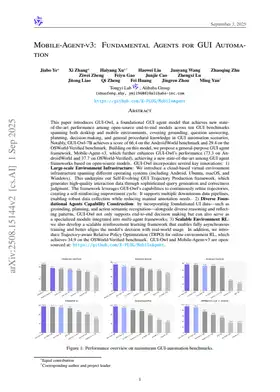
Mobile-Agent-v3: Fundamental Agents for GUI Automation
This paper introduces GUI-Owl, a foundational GUI agent model that achieves state-of-the-art performance among open-source end-to-end models on ten GUI benchmarks across desktop and mobile environments, covering grounding, question answering, planning, decision-making, and procedural knowledge. GUI-Owl-7B achieves 66.4 on AndroidWorld and 29.4 on OSWorld. Building on this, we propose Mobile-Agent-
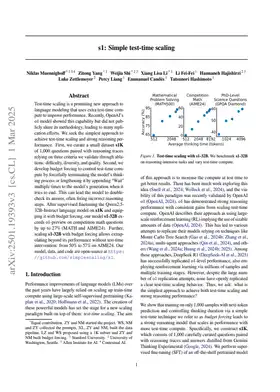
s1: Simple test-time scaling
Test-time scaling is a promising new approach to language modeling that uses extra test-time compute to improve performance. Recently, OpenAI's o1 model showed this capability but did not publicly share its methodology, leading to many replication efforts. We seek the simplest approach to achieve test-time scaling and strong reasoning performance. First, we curate a small dataset s1K of 1,000 ques
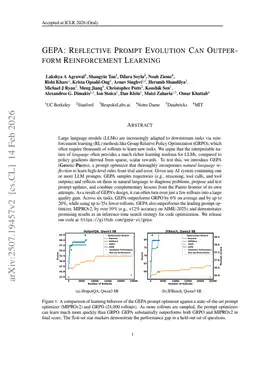
GEPA: Reflective Prompt Evolution Can Outperform Reinforcement Learning
Large language models (LLMs) are increasingly adapted to downstream tasks via reinforcement learning (RL) methods like Group Relative Policy Optimization (GRPO), which often require thousands of rollouts to learn new tasks. We argue that the interpretable nature of language often provides a much richer learning medium for LLMs, compared to policy gradients derived from sparse, scalar rewards. To t
AReaL: A Large-Scale Asynchronous Reinforcement Learning System for Language Reasoning
Reinforcement learning (RL) has become a dominant paradigm for training large language models (LLMs), particularly for reasoning tasks. Effective RL for LLMs requires massive parallelization and poses an urgent need for efficient training systems. Most existing large-scale RL systems for LLMs are synchronous, alternating generation and training in a batch setting where rollouts in each training ba
An Empirical Study on Reinforcement Learning for Reasoning-Search Interleaved LLM Agents
Reinforcement learning (RL) has demonstrated strong potential in training large language models (LLMs) capable of complex reasoning for real-world problem solving. More recently, RL has been leveraged to create sophisticated LLM-based search agents that adeptly combine reasoning with search engine use. While the use of RL for training search agents is promising, the optimal design of such agents r
Search-R1: Training LLMs to Reason and Leverage Search Engines with Reinforcement Learning
Efficiently acquiring external knowledge and up-to-date information is essential for effective reasoning and text generation in large language models (LLMs). Prompting advanced LLMs with reasoning capabilities to use search engines during inference is often suboptimal, as the LLM might not fully possess the capability on how to interact optimally with the search engine. This paper introduces Searc
Visual Confused Deputy: Exploiting and Defending Perception Failures in Computer-Using Agents
Computer-using agents (CUAs) act directly on graphical user interfaces, yet their perception of the screen is often unreliable. Existing work largely treats these failures as performance limitations, asking whether an action succeeds, rather than whether the agent is acting on the correct object at all. We argue that this is fundamentally a security problem. We formalize the visual confused deputy
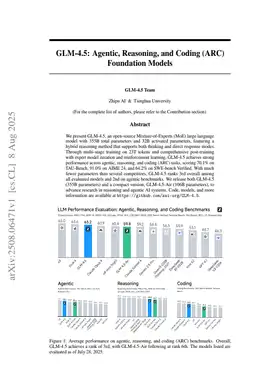
GLM-4.5: Agentic, Reasoning, and Coding (ARC) Foundation Models
We present GLM-4.5, an open-source Mixture-of-Experts (MoE) large language model with 355B total parameters and 32B activated parameters, featuring a hybrid reasoning method that supports both thinking and direct response modes. Through multi-stage training on 23T tokens and comprehensive post-training with expert model iteration and reinforcement learning, GLM-4.5 achieves strong performance acro
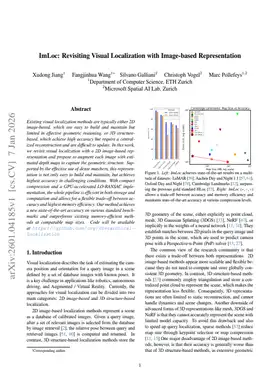
ImLoc: Revisiting Visual Localization with Image-based Representation
Existing visual localization methods are typically either 2D image-based, which are easy to build and maintain but limited in effective geometric reasoning, or 3D structure-based, which achieve high accuracy but require a centralized reconstruction and are difficult to update. In this work, we revisit visual localization with a 2D image-based representation and propose to augment each image with e
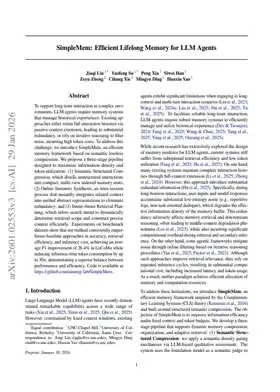
SimpleMem: Efficient Lifelong Memory for LLM Agents
To support long-term interaction in complex environments, LLM agents require memory systems that manage historical experiences. Existing approaches either retain full interaction histories via passive context extension, leading to substantial redundancy, or rely on iterative reasoning to filter noise, incurring high token costs. To address this challenge, we introduce SimpleMem, an efficient memor
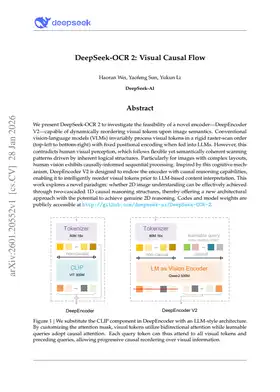
DeepSeek-OCR 2: Visual Causal Flow
We present DeepSeek-OCR 2 to investigate the feasibility of a novel encoder-DeepEncoder V2-capable of dynamically reordering visual tokens upon image semantics. Conventional vision-language models (VLMs) invariably process visual tokens in a rigid raster-scan order (top-left to bottom-right) with fixed positional encoding when fed into LLMs. However, this contradicts human visual perception, which
EvoAgentX: An Automated Framework for Evolving Agentic Workflows
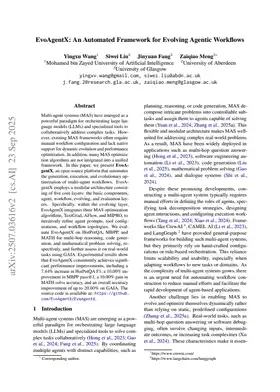
Multi-agent systems (MAS) have emerged as a powerful paradigm for orchestrating large language models (LLMs) and specialized tools to collaboratively address complex tasks. However, existing MAS frameworks often require manual workflow configuration and lack native support for dynamic evolution and performance optimization. In addition, many MAS optimization algorithms are not integrated into a un
EAGLE-3: Scaling up Inference Acceleration of Large Language Models via Training-Time Test
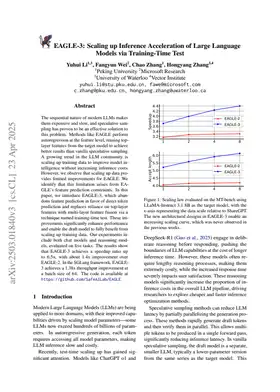
The sequential nature of modern LLMs makes them expensive and slow, and speculative sampling has proven to be an effective solution to this problem. Methods like EAGLE perform autoregression at the feature level, reusing top-layer features from the target model to achieve better results than vanilla speculative sampling. A growing trend in the LLM community is scaling up training data to improve m
GLM-4.5V and GLM-4.1V-Thinking: Towards Versatile Multimodal Reasoning with Scalable Reinforcement Learning
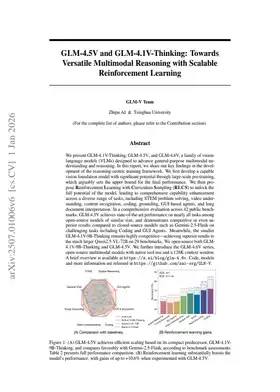
We present GLM-4.1V-Thinking, GLM-4.5V, and GLM-4.6V, a family of vision-language models (VLMs) designed to advance general-purpose multimodal understanding and reasoning. In this report, we share our key findings in the development of the reasoning-centric training framework. We first develop a capable vision foundation model with significant potential through large-scale pre-training, which argu
MiMo: Unlocking the Reasoning Potential of Language Model -- From Pretraining to Posttraining
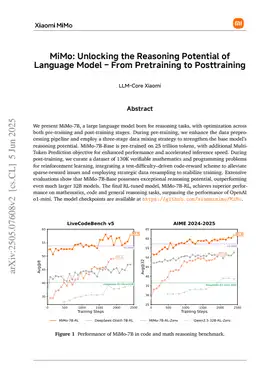
We present MiMo-7B, a large language model born for reasoning tasks, with optimization across both pre-training and post-training stages. During pre-training, we enhance the data preprocessing pipeline and employ a three-stage data mixing strategy to strengthen the base model's reasoning potential. MiMo-7B-Base is pre-trained on 25 trillion tokens, with additional Multi-Token Prediction objective